When does an aerospace conglomerate strategy reduce program risk?
Lead Author
Published
Views:
Large aerospace and advanced-transportation groups are often assumed to be safer places to run complex programs. They have broader engineering depth, larger balance sheets, established supplier networks, and experience dealing with regulators. Those advantages are real, but they do not automatically reduce risk. In some cases, the same breadth creates slow decisions, diluted accountability, incompatible engineering cultures, and internal competition for scarce capital.
The practical question for an enterprise decision-maker is therefore not whether scale is desirable. It is whether an aerospace conglomerate strategy creates reusable capability where it matters most, while preserving a clear owner for delivery, certification, safety, and customer outcomes.
This distinction matters across next-generation aircraft, satellite infrastructure, high-speed rail, urban air mobility, and extreme-environment logistics. These markets increasingly share enabling technologies, from composites and power electronics to digital engineering, autonomy, thermal management, and secure communications. Yet they remain governed by different operating conditions, certification evidence, procurement models, and safety cases. A portfolio can lower risk only when management recognizes both sides of that equation.
Risk reduction starts with the type of risk being managed
“Program risk” is frequently treated as a single category, but it is better understood as a set of connected exposures. A new airframe may face propulsion maturity risk, a certification schedule risk, a constrained titanium or semiconductor supply base, and a cash-flow problem at the same time. A satellite constellation may be technically viable while still carrying launch-access, spectrum, cybersecurity, and operational-resilience risks. A high-speed rail program may depend less on breakthrough technology than on interface control between signaling, civil works, rolling stock, energy systems, and public-sector approvals.
A conglomerate model is useful when its shared functions address these risks directly. It is less useful when it merely adds corporate oversight on top of already crowded program governance.
Decision-makers should first identify the few risks that could materially change cost, schedule, safety, or market access. That exercise tends to clarify whether a broader group structure offers a genuine advantage. For example, a business entering electric vertical takeoff and landing may benefit from access to established flight-test disciplines, configuration control, manufacturing-quality systems, and airworthiness expertise. It gains far less from association with unrelated divisions if those divisions cannot contribute verifiable engineering assets, qualified production capacity, or regulator-recognized processes.
Where cross-sector capability can create a real advantage
The strongest case for an aerospace conglomerate strategy is not generic diversification. It is controlled transfer of capabilities that are expensive, slow, or risky to build separately. These capabilities usually sit below the product level.
- Certification and assurance: Established methods for requirements traceability, safety analysis, software assurance, test evidence, configuration management, and supplier qualification can improve readiness for programs subject to FAA, EASA, ISO, UIC, national rail, defense, or space-sector requirements. The value lies in adapting the process to the new application, not copying a legacy compliance package unchanged.
- Critical engineering talent: Specialists in flight controls, propulsion, systems safety, materials, electromagnetic compatibility, cryogenics, and reliability are limited resources. A group that can assign experienced technical leaders early may prevent avoidable redesign later.
- Digital engineering infrastructure: Shared model-based systems engineering environments, digital thread practices, simulation libraries, and test-data governance can reduce interface failures, provided the underlying models use consistent assumptions and ownership rules.
- Supply-chain intelligence: A wider purchasing base may provide earlier warning of capacity constraints, export-control exposure, single-source dependencies, counterfeit risk, and financial distress among strategic suppliers.
- Industrialization: Aerospace-grade quality management, non-destructive inspection, traceability, production planning, and sustainment experience can be valuable to newer mobility programs moving from prototypes to repeatable delivery.
These are not abstract synergies. They affect concrete decisions, such as whether a propulsion supplier can support qualification testing at production-representative scale, whether a software update has enough evidence for a safety-critical release, or whether a composite structure can be repaired economically in service.
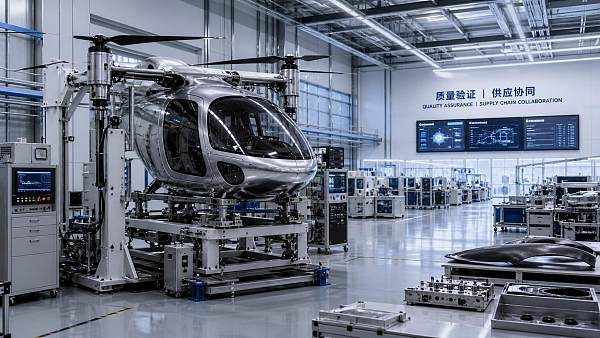
The central discipline is to treat shared assets as services with defined outputs. “Access to group expertise” is too vague for a program plan. A credible arrangement specifies what capability is available, who pays for it, how quickly it can be mobilized, who has final technical authority, and how conflicts are resolved when several programs need the same specialists or test facilities.
Scale becomes a liability when accountability is distributed
Many portfolio strategies fail at the operating-model level. The parent organization retains approval rights, central engineering owns technical standards, a business unit owns the customer relationship, a joint venture owns production, and a separate platform team controls core software. When a schedule slips or a safety finding emerges, no single leader has sufficient authority to make the necessary trade-off.
This is particularly dangerous in regulated mobility markets. Certification authorities and major institutional buyers do not assess organizational charts for elegance; they look for demonstrable control. They need to know who owns the type design, the safety management system, the production quality system, the continuing-airworthiness or maintenance responsibility, and the corrective-action process. Similar questions arise in rail signaling, autonomous operations, and satellite ground infrastructure.
A portfolio structure reduces risk only when the program has an unambiguous accountable executive and a technical authority that cannot be bypassed for commercial reasons. Central teams should set reusable guardrails, conduct independent reviews, and provide scarce expertise. They should not create a second program-management layer that reopens every design decision.
Warning signs during selection or diligence
When evaluating a conglomerate supplier, strategic partner, acquisition target, or internal portfolio model, several patterns deserve scrutiny:
- The claimed synergy is described in financial terms, but no shared engineering process, facility, qualification asset, or named capability is identified.
- Business units use different product lifecycle management, quality, cybersecurity, or configuration-control systems without a defined integration path.
- Key technical personnel are presented as group resources, yet their availability is not contractually or operationally protected.
- Capital allocation is centralized, while delivery accountability sits in a unit that cannot control investment timing.
- A new program assumes that approvals, supplier qualifications, or test evidence from another sector will transfer automatically.
- Governance reports focus on milestone status but do not expose design maturity, test anomalies, certification evidence gaps, or supplier recovery plans.
None of these conditions makes a group model unworkable. They do indicate that projected risk reduction may be overstated. Decision-makers should ask for proof at the work-package level rather than accept a broad narrative about corporate capability.
Technology transfer is valuable, but equivalence must be demonstrated
Aerospace and transportation executives increasingly look across sector boundaries for innovation. Battery systems developed for ground mobility may inform aviation concepts. Autonomous perception and sensor-fusion methods may migrate from rail or road applications into UAM operations. Composite manufacturing techniques can move between aircraft, launch systems, and high-performance rail components. Space-grade communications may support remote logistics operations.
The opportunity is meaningful, but the phrase “proven elsewhere” should trigger technical questions. Proven under what duty cycle, failure tolerance, environmental exposure, maintenance regime, and regulatory basis? A battery acceptable in a road vehicle may face different thermal-runaway containment and continued-safe-flight expectations in an aircraft. A control system validated in a segregated rail corridor may not meet the assurance requirements of a vehicle operating in shared airspace. A component with excellent space performance may be too expensive or difficult to maintain for commercial fleet deployment.
The best conglomerates institutionalize this challenge through a transfer-readiness review. Before a technology is counted as a program advantage, teams examine its maturity, interfaces, certification implications, manufacturability, supply-base position, intellectual-property rights, and lifecycle support model. This does not eliminate uncertainty, but it prevents management from treating a promising technology demonstration as a deployable subsystem.
Capital allocation is often the decisive test
Complex programs do not fail only because the engineering is difficult. They also fail because funding arrives unevenly. A group may commit to commercial aviation, satellite services, advanced rail, autonomous systems, and zero-emission propulsion at once, then discover that several businesses require heavy investment before any reaches stable cash generation.
A diversified balance sheet can cushion this pressure, but it can also conceal it. Mature divisions may be expected to fund speculative projects for longer than planned. Conversely, a strategically important program can lose momentum when a parent redirects resources toward a nearer-term earnings issue, an acquisition, or a political priority. For customers and partners, this is not merely an investor concern. It affects production ramps, spares availability, roadmap continuity, and the willingness to resolve field problems after delivery.
Selection teams should look beyond announced investment figures. More useful questions include whether funding is committed by program phase, what technical or commercial gates release the next tranche, whether critical facilities are shared with competing initiatives, and how leadership decides between sustaining a mature platform and accelerating a new one. The answers reveal whether the portfolio has genuine resilience or simply a larger pool of competing demands.
Supply-chain resilience depends on design choices, not purchasing power alone
Large groups can negotiate volume agreements and build deeper supplier relationships, but purchasing scale does not solve every supply risk. In advanced propulsion, avionics, high-temperature materials, power semiconductors, rare-earth magnets, specialized castings, and certified software tools, the bottleneck may be qualification capacity rather than unit price. In certain cases, export controls, geopolitical restrictions, or proprietary process knowledge matter more than commercial leverage.
A well-run portfolio can help by sharing supplier-performance data, common part strategies, audit capability, and dual-source development costs. It can also create risk when several divisions rely on the same constrained supplier or when internal demand masks a single-point failure.
For this reason, conglomerate claims should be tested against a bill-of-materials view. Which components are common across the portfolio? Which are sole-sourced? Are alternate sources technically qualified, or only commercially identified? Does the group have visibility below tier one? Can engineering redesign an exposed component without destabilizing certification or service support? These questions are more useful than a general statement that the organization has a “global supply chain.”
A practical decision framework
For enterprise buyers, investors, and strategic planners, the decision is rarely between a conglomerate and a pure-play company in the abstract. It is between specific execution models. A focused specialist may deliver faster decisions and deeper domain concentration. A larger group may offer stronger assurance systems, broader resources, and better endurance through long development cycles. The right choice depends on the program’s dominant constraints.
Consider a conglomerate model when the program requires several of the following at once: safety-critical systems integration, long certification cycles, access to capital-intensive test infrastructure, complex international supply chains, multi-decade support commitments, and technical interfaces spanning air, space, rail, energy, or digital operations.
Use more caution when the opportunity depends on a narrow market window, rapid product iteration, a highly distinct customer workflow, or a technology that would be slowed by legacy approval processes. In those situations, the group should prove that it can ring-fence the venture’s decision speed while still applying appropriate safety, quality, and financial controls.
The most reliable indicator is evidence of prior execution. Decision-makers should examine how the organization handled a difficult certification event, a supplier disruption, a production-quality issue, or a safety-critical redesign. Public messaging around innovation is less informative than the record of corrective action, governance discipline, and customer support under pressure.
In the coming years, pressure to combine capabilities will increase as aviation decarbonization, autonomous mobility, resilient logistics, secure communications, and infrastructure modernization converge. That will make the aerospace conglomerate strategy more attractive on paper. Its success, however, will still depend on a simpler standard: shared capability must make the accountable program team more capable of delivering, rather than more dependent on a larger organization’s internal complexity.
Article Categories
SYSTEM_ALERT_URGENT
Q3 SYMPOSIUM ON ORBITAL DYNAMICS
Registration for the Orbital Aerospace technical committee is now open. Node access required.
Recent Articles
![]() Oct 27, 2026FAA Certifies Boeing 737 MAX 10 After Years of DelaysFAA Certifies Boeing 737 MAX 10 After Years of Delays
Oct 27, 2026FAA Certifies Boeing 737 MAX 10 After Years of DelaysFAA Certifies Boeing 737 MAX 10 After Years of Delays Oct 27, 2026Can an intermodal connectivity platform reduce rail handoff delays?Can an intermodal connectivity platform reduce rail handoff delays?
![]() Oct 26, 2026Chery Unveils Global Smart Mobility Strategy Targeting Robotaxis and eVTOLsChery Unveils Global Smart Mobility Strategy Targeting Robotaxis and eVTOLs
Oct 26, 2026Chery Unveils Global Smart Mobility Strategy Targeting Robotaxis and eVTOLsChery Unveils Global Smart Mobility Strategy Targeting Robotaxis and eVTOLs Oct 26, 2026How to evaluate avionics for helicopters used in IFR operationsHow to evaluate avionics for helicopters used in IFR operations
![]() Oct 25, 2026Ukraine’s Defence Minister Says SpaceX Satellite Services Restored After Speed RestrictionsUkraine’s Defence Minister Says SpaceX Satellite Services Restored After Speed Restrictions
Oct 25, 2026Ukraine’s Defence Minister Says SpaceX Satellite Services Restored After Speed RestrictionsUkraine’s Defence Minister Says SpaceX Satellite Services Restored After Speed Restrictions Oct 25, 2026How satellite infrastructure for IoT affects sensor reporting delaysHow satellite infrastructure for IoT affects sensor reporting delays
![]() Oct 24, 2026China Successfully Launches Yaogan 50-03 SatelliteChina Successfully Launches Yaogan 50-03 Satellite
Oct 24, 2026China Successfully Launches Yaogan 50-03 SatelliteChina Successfully Launches Yaogan 50-03 Satellite Oct 24, 2026How gradients affect traction power needs in high-speed rolling stockHow gradients affect traction power needs in high-speed rolling stock
![]() Oct 23, 2026FAA Proposes Checks on Nearly 2,000 Boeing 737NGs Over Loss-of-Control RiskFAA Proposes Checks on Nearly 2,000 Boeing 737NGs Over Loss-of-Control Risk
Oct 23, 2026FAA Proposes Checks on Nearly 2,000 Boeing 737NGs Over Loss-of-Control RiskFAA Proposes Checks on Nearly 2,000 Boeing 737NGs Over Loss-of-Control Risk Oct 23, 2026How fuel choice affects specific impulse in liquid oxygen propulsionHow fuel choice affects specific impulse in liquid oxygen propulsion
![]() Oct 22, 2026QuantumScape Plans 100 MWh Solid-State Battery Line Targeting Aerospace and Other MarketsQuantumScape Plans 100 MWh Solid-State Battery Line Targeting Aerospace and Other Markets
Oct 22, 2026QuantumScape Plans 100 MWh Solid-State Battery Line Targeting Aerospace and Other MarketsQuantumScape Plans 100 MWh Solid-State Battery Line Targeting Aerospace and Other Markets Oct 22, 2026How tank size limits hydrogen aircraft range on regional flightsHow tank size limits hydrogen aircraft range on regional flights
![]() Oct 21, 2026FAA Certifies Boeing 737-10, Clearing Regulatory Hurdle for DeliveriesFAA Certifies Boeing 737-10, Clearing Regulatory Hurdle for Deliveries
Oct 21, 2026FAA Certifies Boeing 737-10, Clearing Regulatory Hurdle for DeliveriesFAA Certifies Boeing 737-10, Clearing Regulatory Hurdle for Deliveries Oct 21, 2026How are electric vertical takeoff aircraft certified in the US?How are electric vertical takeoff aircraft certified in the US?
![]() Oct 20, 2026Ohio Department of Transportation Releases Three-Year Advanced Air Mobility Action PlanOhio Department of Transportation Releases Three-Year Advanced Air Mobility Action Plan
Oct 20, 2026Ohio Department of Transportation Releases Three-Year Advanced Air Mobility Action PlanOhio Department of Transportation Releases Three-Year Advanced Air Mobility Action Plan Oct 20, 2026How does magnetic flux density in tesla affect maglev lift force?How does magnetic flux density in tesla affect maglev lift force?
![]() Oct 19, 2026ZeroAvia Completes Key Ground Tests of ZA600 Hydrogen Fuel Cell PowertrainZeroAvia Completes Key Ground Tests of ZA600 Hydrogen Fuel Cell Powertrain
Oct 19, 2026ZeroAvia Completes Key Ground Tests of ZA600 Hydrogen Fuel Cell PowertrainZeroAvia Completes Key Ground Tests of ZA600 Hydrogen Fuel Cell Powertrain Oct 19, 2026How spacecraft integration affects advanced propulsion costsHow spacecraft integration affects advanced propulsion costs
 Oct 18, 2026How chilldown prevents cavitation in cryogenic engine systemsHow chilldown prevents cavitation in cryogenic engine systems
 Oct 17, 2026How explainability affects algorithmic trust in AI flight systemsHow explainability affects algorithmic trust in AI flight systems
 Oct 16, 2026How to evaluate transportation technology for Middle East heatHow to evaluate transportation technology for Middle East heat
 Oct 15, 2026How common-cause failures defeat redundancy logic in European avionicsHow common-cause failures defeat redundancy logic in European avionics
 Oct 14, 2026How DO-160 applies to aerospace technology testing for avionicsHow DO-160 applies to aerospace technology testing for avionics
 Oct 13, 2026How fuel price volatility shapes commercial aviation cost trendsHow fuel price volatility shapes commercial aviation cost trends
 Oct 12, 2026How to qualify aerospace manufacturing components for traceabilityHow to qualify aerospace manufacturing components for traceability
 Oct 11, 2026Which certification hurdles are slowing hydrogen aviation in Europe?Which certification hurdles are slowing hydrogen aviation in Europe?
 Oct 10, 2026What evidence should a magnetic gap stability supplier provide?What evidence should a magnetic gap stability supplier provide?
 Oct 09, 2026Which ISO standards matter when qualifying industrial technology suppliers?Which ISO standards matter when qualifying industrial technology suppliers?
 Oct 08, 2026When does reusability actually lower launch vehicle costs?When does reusability actually lower launch vehicle costs?
 Oct 07, 2026Where to find reliable product knowledge resources in the Middle EastWhere to find reliable product knowledge resources in the Middle East
 Oct 06, 2026What drives high-speed rail systems cost per kilometer?What drives high-speed rail systems cost per kilometer?
 Oct 05, 2026When does hydrogen propulsion for UAV extend mission range enough to justify it?When does hydrogen propulsion for UAV extend mission range enough to justify it?
 Oct 04, 2026How rail systems integration reduces commissioning delaysHow rail systems integration reduces commissioning delays
 Oct 03, 2026How to evaluate an advanced propulsion manufacturer for hydrogen systemsHow to evaluate an advanced propulsion manufacturer for hydrogen systems
 Oct 02, 2026How to qualify aircraft components for OEM production approvalHow to qualify aircraft components for OEM production approval