Custom Metal Fabrication for Aerospace: Tolerance Red Flags
Lead Author
Published
Views:
In aerospace manufacturing, a minor tolerance drift can trigger major safety, compliance, and cost consequences. For quality and safety teams, custom metal fabrication for aerospace demands more than precision on paper—it requires early detection of red flags that threaten structural integrity, certification readiness, and long-term reliability. This article highlights the warning signs you cannot afford to overlook.
For quality managers, supplier auditors, and safety leaders working across advanced aviation, space systems, eVTOL platforms, and extreme-environment transport programs, tolerance control is not a narrow machining issue. It affects fit-up, fatigue life, traceability, inspection planning, and downstream approvals under FAA, EASA, ISO, and other program-specific requirements.
Within high-consequence manufacturing environments such as those benchmarked by G-AIT, the most expensive failures often begin with small deviations: a hole pattern drifting by 0.15 mm, a flange angle varying by 0.8°, or a thermal distortion trend that stays hidden until assembly week. The goal is early visibility, not late-stage rework.
Why Tolerance Red Flags Matter in Aerospace Fabrication
In custom metal fabrication for aerospace, tolerances are tied directly to airworthiness, repeatability, and service reliability. A nonconformance that appears minor in a stand-alone component can multiply across 20, 50, or 200 mating parts in a larger subassembly.
This is especially true in structures exposed to vibration, pressure cycling, thermal gradients, and corrosive operating conditions. A bracket, panel, housing, duct, or machined fitting that falls outside its intended tolerance window may still look acceptable visually, yet fail functionally during installation or long-term operation.
The cost of a small drift becomes large very quickly
In most aerospace programs, a tolerance issue creates at least 4 layers of impact: containment, investigation, rework, and schedule disruption. If the part is already integrated into a higher-level assembly, a single out-of-tolerance feature can trigger disassembly, replacement inspection, and concession review.
For quality and safety teams, the practical concern is not only scrap cost. It is whether the deviation affects load paths, fastener engagement, sealing performance, EMI shielding, thermal management, or certification evidence. Those risks are harder to reverse once the build moves beyond first article stage.
Where red flags usually appear
- Hole location and positional tolerance drift in multi-hole patterns
- Flatness, straightness, and profile deviation after forming or welding
- Heat-related distortion after stress relief, brazing, or coating cycles
- Variable wall thickness in machined pockets or thin-gauge formed parts
- Mismatch between CAD nominal values, inspection reports, and shop-floor capability
- Inconsistent repeatability between first-off, mid-batch, and final-batch parts
High-risk environments amplify these issues
Programs involving cryogenic exposure, high-speed airflow, pressurized fuselage structures, propulsion interfaces, or autonomous mobility platforms demand tighter process discipline. In these environments, even a 1% dimensional deviation in a critical feature can affect fatigue margin, clearance control, or sensor alignment.
The table below highlights how common tolerance deviations in custom metal fabrication for aerospace translate into quality and safety consequences for different applications.
The key pattern is clear: the red flag is rarely the number alone. The real problem is the functional consequence of that deviation in a flight-critical or mission-critical context. That is why quality teams should evaluate tolerance issues through both dimensional and operational lenses.
The Most Important Red Flags to Catch Early
Not every variation indicates systemic failure, but several warning signs deserve immediate escalation. In custom metal fabrication for aerospace, recurring patterns are often more dangerous than isolated defects because they reveal process instability rather than operator error alone.
Red flag 1: Tolerances that look achievable on drawings but fail in production
A common issue appears when the drawing calls for features such as ±0.05 mm on long formed parts, tight profile controls across mixed-material assemblies, or very narrow perpendicularity limits without a realistic process route. If capability studies are missing, the nominal tolerance may be theoretical rather than manufacturable.
Quality teams should ask for evidence of Cp or Cpk trends where appropriate, first article inspection data, gauge method validation, and process-specific control plans. If the supplier cannot explain how a tolerance is achieved across 3 consecutive lots, the risk level rises.
Red flag 2: Excessive dependence on manual rework
Minor deburring and finish correction are normal. Repeated hand-blending, slot opening, hole enlargement, or bend correction is not. When more than 10% to 15% of parts need manual intervention to pass inspection, consistency and traceability become weak points.
Manual rework may also mask root causes such as worn tooling, poor fixture design, unstable clamping, or uncontrolled thermal input. For safety managers, the concern is whether undocumented local geometry changes affect thickness, edge distance, or surface integrity.
Red flag 3: Distortion after secondary processes
Many dimensional escapes do not originate during primary cutting or machining. They show up after welding, heat treatment, anodizing, plating, or shot peening. Thin-wall titanium, aluminum, and high-strength steel parts are particularly sensitive when residual stress is not controlled.
If inspection occurs only before finishing, teams may miss a 0.25 mm to 0.80 mm shape movement that pushes the final part outside assembly requirements. A robust control plan should include pre-process, post-process, and final verification at critical stages.
Red flag 4: Measurement systems that are less capable than the tolerance band
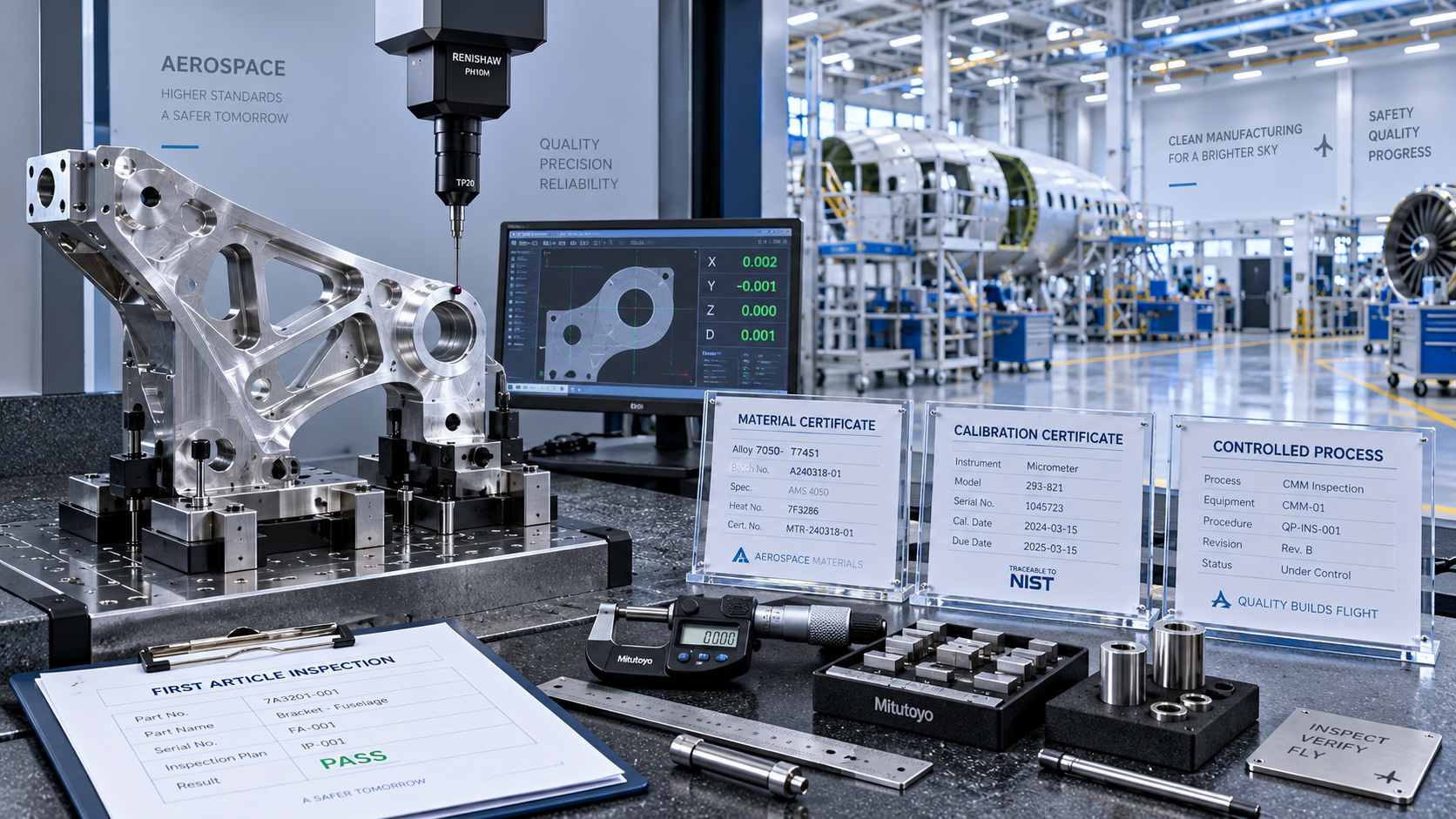
A part cannot be controlled better than it can be measured. If a feature tolerance is ±0.08 mm but the inspection approach relies on unstable fixturing, inadequate datum simulation, or a measurement uncertainty too close to the acceptance limit, results become hard to trust.
For critical aerospace parts, quality teams should verify gauge repeatability, CMM strategy, probing access, thermal compensation, and revision alignment between drawing, model, and inspection plan. A mismatch here can produce false accepts or false rejects.
Red flag 5: Incomplete material and process traceability
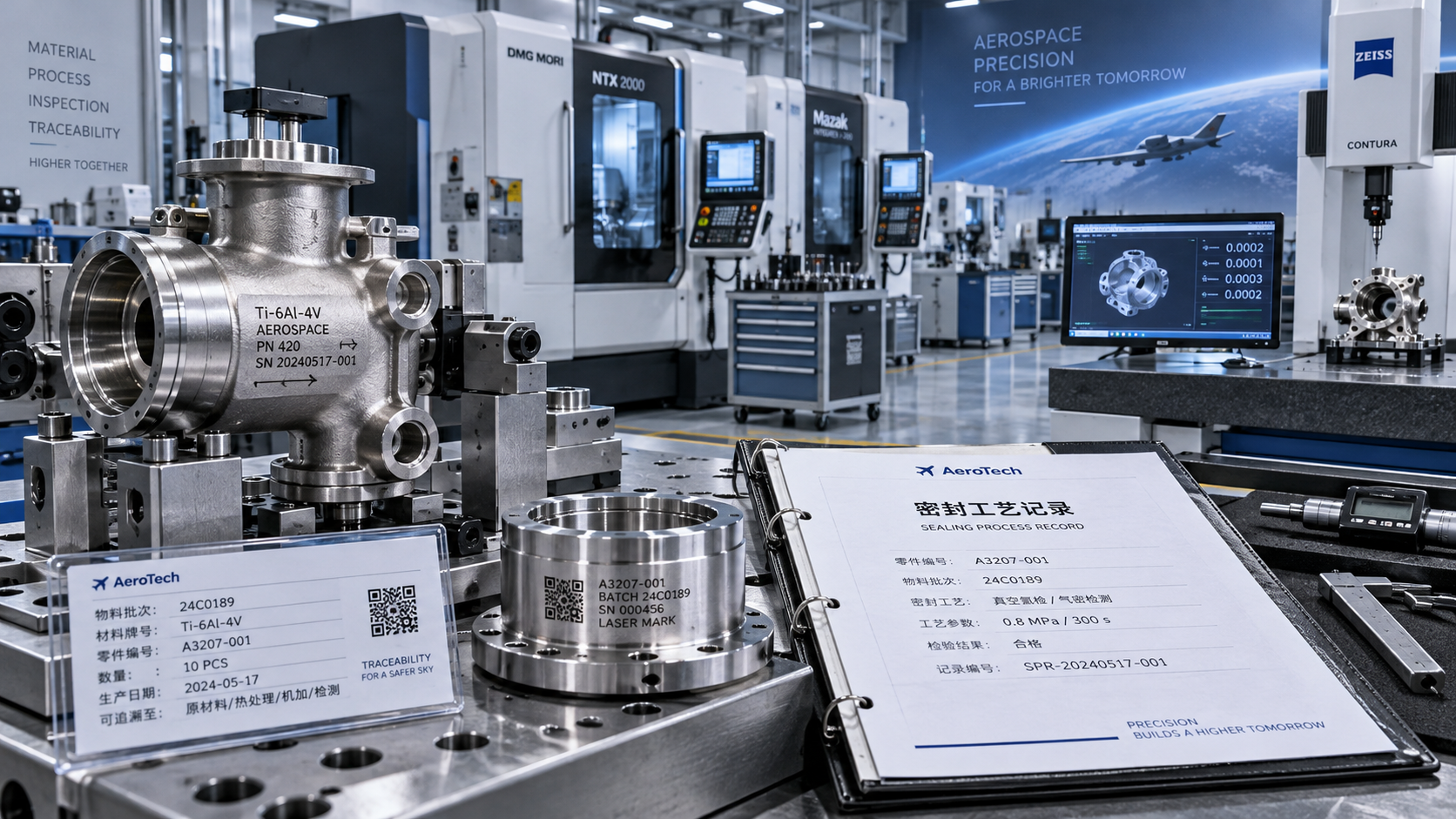
Traceability gaps are not purely documentation issues. They limit the ability to connect tolerance drift with material batch behavior, forming response, weld input, or heat treatment exposure. In aerospace, every nonconformance needs a credible chain from raw stock to finished inspection record.
If a supplier cannot quickly produce lot linkage for raw material, process traveler, operator sign-off, and final dimensional release, the risk extends beyond one part number. It affects containment speed and corrective action quality across the program.
Red flag 6: Late detection at assembly rather than early detection at fabrication
The most expensive quality signal is the one discovered after shipment or during final integration. When tolerance issues are first identified at assembly, the organization has already absorbed logistics cost, schedule exposure, and cross-functional disruption.
A mature custom metal fabrication for aerospace workflow should front-load risk review, first article validation, fixture verification, and in-process inspection. The earlier the detection point, the lower the cost of correction.
How Quality and Safety Teams Should Evaluate Suppliers
Supplier approval should go beyond certificates and sample parts. For custom metal fabrication for aerospace, the real question is whether the supplier can sustain dimensional stability over time, across multiple geometries, materials, and process sequences.
Five evaluation areas that matter most
- Process capability on critical dimensions, not only overall quality rate
- Inspection depth at first article, in-process, and final release stages
- Control of secondary-process distortion and residual stress behavior
- Traceability from raw material heat or lot to final packed shipment
- Corrective action speed, including containment within 24 to 72 hours
Questions worth asking during audit or RFQ review
Ask how the supplier manages tolerance stack-up across fabricated and machined interfaces. Ask whether complex parts are validated with digital inspection, hard tooling checks, or both. Ask how they control springback, thermal movement, and lot-to-lot variation in materials such as aluminum, Inconel, stainless, or titanium.
Also ask for examples of parts requiring 3-stage verification: before forming, after forming, and after finishing. This reveals whether the supplier understands that the final geometry is shaped by the full process chain, not one isolated operation.
The table below offers a practical audit framework for quality and safety professionals comparing aerospace fabrication partners.
A useful takeaway is that supplier quality maturity shows up in process behavior, not only paperwork. Strong documentation without dimensional stability is not enough. For aerospace buyers and auditors, sustained repeatability is the real proof of control.
Practical Controls That Reduce Tolerance Risk
The best prevention strategy combines engineering review, production discipline, and inspection timing. Quality and safety teams should push for controls that reduce the chance of hidden drift rather than only catching defects at the end.
Build a staged verification plan
For complex parts, a 3-step or 4-step verification plan is often more effective than one final inspection. Typical checkpoints include raw blank verification, post-form or post-machine check, post-secondary-process check, and final release inspection. This structure isolates when the deviation was introduced.
Control tolerance stack-up before release
Aerospace assemblies fail fit-up when individually conforming parts combine into a nonconforming system. That is why custom metal fabrication for aerospace should include stack-up review for datum schemes, interface features, hole patterns, and mating surfaces before production launch.
Do not separate quality planning from fabrication planning
If the inspection plan is created after the routing is fixed, critical distortion risks may already be baked into the process. Quality planning should start during manufacturability review, ideally at RFQ or pre-production stage, when fixture logic, process order, and tolerance realism can still be challenged.
Useful control actions for high-risk parts
- Flag features tighter than ±0.10 mm for capability confirmation before release
- Require post-finish verification for thin-wall or thermally sensitive components
- Use dedicated fixtures for repeat geometry instead of operator-dependent alignment
- Separate cosmetic acceptance from functional acceptance in inspection criteria
- Review rework frequency monthly; more than 5% recurrence on one feature warrants root cause action
- Align engineering, quality, and supplier teams on concession thresholds before shipment
Common Misjudgments That Put Programs at Risk
Several recurring assumptions lead to late surprises. One is believing that a capable CNC process guarantees a capable fabricated assembly. Another is assuming that a passing first article means ongoing process control. In reality, aerospace fabrication risk often appears in batch variation, tooling wear, or secondary-process distortion over time.
Another misjudgment is treating tolerance issues as supplier-only problems. Internal approval timing, unclear datums, overconstrained drawings, and poorly sequenced engineering changes can all create nonconformance pressure. Effective quality leadership addresses both supplier execution and customer-side specification clarity.
FAQ for quality and safety teams
When should a tolerance issue trigger escalation?
Escalate immediately when the deviation affects critical interfaces, load-bearing geometry, pressurized boundaries, sealing surfaces, or certification evidence. Escalation is also appropriate when the same defect appears in 2 or more lots, even if each case seems minor on its own.
Is 100% inspection the answer?
Not always. For some critical characteristics, yes. But if the process itself is unstable, 100% inspection only contains the symptom. Long-term control requires process correction, fixture improvement, clearer datums, or revised sequencing of fabrication and finishing operations.
What should be included in a supplier discussion after a tolerance escape?
At minimum, review the affected feature, batch scope, containment timing, measurement method, process step where drift likely occurred, and the verification plan preventing recurrence. A strong response is specific, measurable, and time-bound, usually with follow-up checks over the next 2 to 3 production runs.
Tolerance red flags in custom metal fabrication for aerospace rarely stay isolated for long. They spread into assembly delays, certification risk, field reliability concerns, and avoidable cost if not addressed early. For quality and safety teams, the priority is to detect instability before parts move too far downstream.
Organizations operating in advanced aviation, space infrastructure, high-speed mobility, and other safety-critical sectors need fabrication partners that understand dimensional control as a system discipline, not a final inspection task. If you are reviewing suppliers, refining audit criteria, or planning tighter controls for complex parts, now is the right time to act.
Contact us to discuss your inspection priorities, request a tailored evaluation framework, or explore custom solutions for high-reliability aerospace fabrication programs.
Article Categories
SYSTEM_ALERT_URGENT
Q3 SYMPOSIUM ON ORBITAL DYNAMICS
Registration for the Orbital Aerospace technical committee is now open. Node access required.
Taglist:
Recent Articles
![]() Oct 27, 2026FAA Certifies Boeing 737 MAX 10 After Years of DelaysFAA Certifies Boeing 737 MAX 10 After Years of Delays
Oct 27, 2026FAA Certifies Boeing 737 MAX 10 After Years of DelaysFAA Certifies Boeing 737 MAX 10 After Years of Delays Oct 27, 2026Can an intermodal connectivity platform reduce rail handoff delays?Can an intermodal connectivity platform reduce rail handoff delays?
![]() Oct 26, 2026Chery Unveils Global Smart Mobility Strategy Targeting Robotaxis and eVTOLsChery Unveils Global Smart Mobility Strategy Targeting Robotaxis and eVTOLs
Oct 26, 2026Chery Unveils Global Smart Mobility Strategy Targeting Robotaxis and eVTOLsChery Unveils Global Smart Mobility Strategy Targeting Robotaxis and eVTOLs Oct 26, 2026How to evaluate avionics for helicopters used in IFR operationsHow to evaluate avionics for helicopters used in IFR operations
![]() Oct 25, 2026Ukraine’s Defence Minister Says SpaceX Satellite Services Restored After Speed RestrictionsUkraine’s Defence Minister Says SpaceX Satellite Services Restored After Speed Restrictions
Oct 25, 2026Ukraine’s Defence Minister Says SpaceX Satellite Services Restored After Speed RestrictionsUkraine’s Defence Minister Says SpaceX Satellite Services Restored After Speed Restrictions Oct 25, 2026How satellite infrastructure for IoT affects sensor reporting delaysHow satellite infrastructure for IoT affects sensor reporting delays
![]() Oct 24, 2026China Successfully Launches Yaogan 50-03 SatelliteChina Successfully Launches Yaogan 50-03 Satellite
Oct 24, 2026China Successfully Launches Yaogan 50-03 SatelliteChina Successfully Launches Yaogan 50-03 Satellite Oct 24, 2026How gradients affect traction power needs in high-speed rolling stockHow gradients affect traction power needs in high-speed rolling stock
![]() Oct 23, 2026FAA Proposes Checks on Nearly 2,000 Boeing 737NGs Over Loss-of-Control RiskFAA Proposes Checks on Nearly 2,000 Boeing 737NGs Over Loss-of-Control Risk
Oct 23, 2026FAA Proposes Checks on Nearly 2,000 Boeing 737NGs Over Loss-of-Control RiskFAA Proposes Checks on Nearly 2,000 Boeing 737NGs Over Loss-of-Control Risk Oct 23, 2026How fuel choice affects specific impulse in liquid oxygen propulsionHow fuel choice affects specific impulse in liquid oxygen propulsion
![]() Oct 22, 2026QuantumScape Plans 100 MWh Solid-State Battery Line Targeting Aerospace and Other MarketsQuantumScape Plans 100 MWh Solid-State Battery Line Targeting Aerospace and Other Markets
Oct 22, 2026QuantumScape Plans 100 MWh Solid-State Battery Line Targeting Aerospace and Other MarketsQuantumScape Plans 100 MWh Solid-State Battery Line Targeting Aerospace and Other Markets Oct 22, 2026How tank size limits hydrogen aircraft range on regional flightsHow tank size limits hydrogen aircraft range on regional flights
![]() Oct 21, 2026FAA Certifies Boeing 737-10, Clearing Regulatory Hurdle for DeliveriesFAA Certifies Boeing 737-10, Clearing Regulatory Hurdle for Deliveries
Oct 21, 2026FAA Certifies Boeing 737-10, Clearing Regulatory Hurdle for DeliveriesFAA Certifies Boeing 737-10, Clearing Regulatory Hurdle for Deliveries Oct 21, 2026How are electric vertical takeoff aircraft certified in the US?How are electric vertical takeoff aircraft certified in the US?
![]() Oct 20, 2026Ohio Department of Transportation Releases Three-Year Advanced Air Mobility Action PlanOhio Department of Transportation Releases Three-Year Advanced Air Mobility Action Plan
Oct 20, 2026Ohio Department of Transportation Releases Three-Year Advanced Air Mobility Action PlanOhio Department of Transportation Releases Three-Year Advanced Air Mobility Action Plan Oct 20, 2026How does magnetic flux density in tesla affect maglev lift force?How does magnetic flux density in tesla affect maglev lift force?
![]() Oct 19, 2026ZeroAvia Completes Key Ground Tests of ZA600 Hydrogen Fuel Cell PowertrainZeroAvia Completes Key Ground Tests of ZA600 Hydrogen Fuel Cell Powertrain
Oct 19, 2026ZeroAvia Completes Key Ground Tests of ZA600 Hydrogen Fuel Cell PowertrainZeroAvia Completes Key Ground Tests of ZA600 Hydrogen Fuel Cell Powertrain Oct 19, 2026How spacecraft integration affects advanced propulsion costsHow spacecraft integration affects advanced propulsion costs
 Oct 18, 2026How chilldown prevents cavitation in cryogenic engine systemsHow chilldown prevents cavitation in cryogenic engine systems
 Oct 17, 2026How explainability affects algorithmic trust in AI flight systemsHow explainability affects algorithmic trust in AI flight systems
 Oct 16, 2026How to evaluate transportation technology for Middle East heatHow to evaluate transportation technology for Middle East heat
 Oct 15, 2026How common-cause failures defeat redundancy logic in European avionicsHow common-cause failures defeat redundancy logic in European avionics
 Oct 14, 2026How DO-160 applies to aerospace technology testing for avionicsHow DO-160 applies to aerospace technology testing for avionics
 Oct 13, 2026How fuel price volatility shapes commercial aviation cost trendsHow fuel price volatility shapes commercial aviation cost trends
 Oct 12, 2026How to qualify aerospace manufacturing components for traceabilityHow to qualify aerospace manufacturing components for traceability
 Oct 11, 2026Which certification hurdles are slowing hydrogen aviation in Europe?Which certification hurdles are slowing hydrogen aviation in Europe?
 Oct 10, 2026What evidence should a magnetic gap stability supplier provide?What evidence should a magnetic gap stability supplier provide?
 Oct 09, 2026Which ISO standards matter when qualifying industrial technology suppliers?Which ISO standards matter when qualifying industrial technology suppliers?
 Oct 08, 2026When does reusability actually lower launch vehicle costs?When does reusability actually lower launch vehicle costs?
 Oct 07, 2026Where to find reliable product knowledge resources in the Middle EastWhere to find reliable product knowledge resources in the Middle East
 Oct 06, 2026What drives high-speed rail systems cost per kilometer?What drives high-speed rail systems cost per kilometer?
 Oct 05, 2026When does hydrogen propulsion for UAV extend mission range enough to justify it?When does hydrogen propulsion for UAV extend mission range enough to justify it?
 Oct 04, 2026How rail systems integration reduces commissioning delaysHow rail systems integration reduces commissioning delays
 Oct 03, 2026How to evaluate an advanced propulsion manufacturer for hydrogen systemsHow to evaluate an advanced propulsion manufacturer for hydrogen systems
 Oct 02, 2026How to qualify aircraft components for OEM production approvalHow to qualify aircraft components for OEM production approval