Advanced Propulsion Lightweight Designs: Performance vs Durability
Lead Author
Published
Views:
In aerospace and advanced transportation, weight reduction is no longer a narrow design target. It directly influences range, acceleration, payload, energy use, thermal margins, and maintenance intervals. That is why advanced propulsion lightweight design has become a central topic across aircraft, launch systems, eVTOL platforms, high-speed rail, and other mobility systems where every kilogram affects performance.
The harder question is not how to remove mass, but how to remove it without weakening the structure around propulsion loads. Heat, vibration, pressure cycles, debris exposure, and fatigue can quickly erase efficiency gains if durability is treated as a secondary issue.
Within the G-AIT perspective, this balance matters because future mobility is being shaped by systems that must be fast, efficient, certifiable, and dependable at scale. Advanced propulsion lightweight strategies only create lasting value when they perform under real operating conditions, not just in ideal test environments.
Why the tradeoff has become more visible
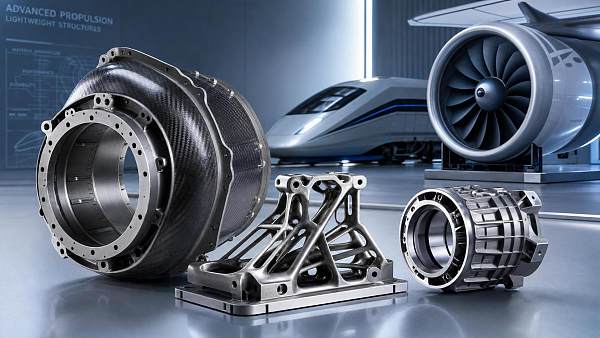
The current generation of mobility platforms is asking more from propulsion systems than older architectures did. Engines, motors, power electronics, thermal shielding, and support structures are all being pushed toward higher efficiency and tighter packaging.
That pressure changes the role of lightweight design. It is no longer limited to airframe skins or secondary brackets. It now reaches into nacelles, battery enclosures, cryogenic tanks, rotor assemblies, motor housings, ducts, railside equipment, and structural interfaces.
In practical terms, advanced propulsion lightweight decisions are showing up where thermal stress and structural stress overlap. A component may be lighter and stronger in a static test, yet less reliable after repeated startup cycles or vibration-rich service.
This is especially relevant in sectors tracked by G-AIT. Zero-emission aviation, sub-orbital logistics, autonomous rail, and urban air mobility all depend on propulsion-adjacent structures that operate close to performance limits while still meeting FAA, EASA, UIC, and ISO expectations.
What advanced propulsion lightweight really means
The phrase often sounds simple, but it covers several engineering choices at once. It includes materials, structural layout, thermal protection, manufacturing methods, inspection strategy, and service-life assumptions.
A useful way to understand advanced propulsion lightweight design is to see it as mass optimization around propulsion functions, not mass reduction everywhere. Some areas should become lighter. Others may need reinforcement, better damping, or more thermal stability.
For example, a lighter motor housing may improve power-to-weight ratio. But if the redesign increases heat concentration or makes crack detection harder, the operational result may be worse. Performance gains that complicate inspection or shorten replacement intervals are not always true gains.
That is why strong advanced propulsion lightweight programs rely on system-level thinking. Material selection must align with the load path, the duty cycle, the maintenance model, and the certification path.
Common design levers
- High-performance composites for ducts, casings, fairings, and structural shells
- Titanium, aluminum-lithium, and hybrid alloys for high-strength, lower-mass components
- Topology optimization for brackets, mounts, and support frames
- Additive manufacturing for complex internal geometries and part consolidation
- Integrated thermal management to prevent local overheating in lighter assemblies
- Sensor-ready designs that simplify inspection and health monitoring
Where durability problems usually emerge
Durability rarely fails in the abstract. It fails at interfaces, transitions, repeated cycles, and off-design events. Lightweight propulsion structures often perform well until those details are tested over time.
The most frequent issue is not insufficient strength on paper. It is mismatch between predicted loading and actual service exposure. A design can pass analysis but still degrade under vibration harmonics, thermal shock, moisture ingress, or maintenance handling.
These risks do not argue against advanced propulsion lightweight design. They clarify where validation needs to be deeper. The design target should be stable service performance, not isolated laboratory efficiency.
How this plays out across mobility segments
The same principle appears in different forms across G-AIT’s five industrial pillars. The materials and standards change, but the tension between lower mass and dependable service remains consistent.
Advanced commercial aviation
In next-generation airframes, lighter propulsion structures can reduce fuel burn and extend range. But nacelle systems, mounts, thermal barriers, and rotating interfaces must tolerate long service cycles and strict inspection schedules.
Space exploration and satellite infrastructure
Launch systems benefit strongly from each kilogram removed. Yet cryogenic exposure, rapid thermal shifts, and dynamic ascent loads create extreme conditions. Here, advanced propulsion lightweight choices must survive environments that leave little recovery margin.
High-speed rail and maglev engineering
Rail systems use lightweight strategies in propulsion-adjacent equipment, cooling systems, and high-speed structural supports. Durability matters because vibration, environmental exposure, and continuous operation create long-term fatigue patterns that can be easy to underestimate.
Urban air mobility and eVTOL
This segment is especially sensitive to weight. Distributed propulsion, battery mass, acoustic constraints, and short mission cycles push designers toward aggressive optimization. At the same time, repetitive takeoff and landing loads can punish weak durability assumptions very quickly.
Extreme-environment logistics
Specialized vehicles and platforms often face dust, salt, ice, heat, and remote maintenance limits. A lighter propulsion-related assembly only helps if it remains inspectable and serviceable under these conditions.
How to judge real value in practice
In real operations, the best advanced propulsion lightweight solution is rarely the lightest available option. It is the one that improves mission efficiency without creating hidden penalties in uptime, maintenance burden, or certification complexity.
A sound evaluation usually starts with the duty cycle. Long-haul, high-frequency, high-thermal, and stop-start profiles place very different demands on the same component category.
After that, it helps to compare lightweight gains against durability evidence in a structured way.
- Measure mass reduction against total system impact, not part-level numbers alone
- Check thermal cycling data, not just peak temperature capability
- Review vibration and fatigue behavior at interfaces and mounting points
- Confirm inspection access, repairability, and non-destructive testing compatibility
- Look for certification alignment early, especially where materials or manufacturing methods are novel
- Consider supply consistency, because advanced materials are only as useful as their repeatable quality
This is where benchmarking becomes valuable. G-AIT’s cross-sector view is useful because lessons from aerospace, rail, and space systems often reveal the same weak points in different forms.
A better path than simple weight reduction
The strongest programs treat advanced propulsion lightweight design as a controlled balancing exercise. They combine material science, propulsion behavior, structural dynamics, certification logic, and maintenance planning from the start.
That approach tends to produce better outcomes than chasing minimum mass alone. It also reduces the risk of redesign late in development, where failures become much more expensive.
For near-term decisions, it makes sense to map each lightweight opportunity against four questions: where the mass matters most, what load conditions dominate, how the part will be inspected, and which standards shape acceptance.
From there, the next step is usually straightforward: compare candidate designs using real duty-cycle data, durability evidence, and compliance readiness rather than headline weight savings. In advanced mobility, the best advanced propulsion lightweight decision is the one that keeps performance and reliability moving in the same direction.
Article Categories
SYSTEM_ALERT_URGENT
Q3 SYMPOSIUM ON ORBITAL DYNAMICS
Registration for the Orbital Aerospace technical committee is now open. Node access required.
Taglist:
- Space Exploration
- Satellite Infrastructure
- High-Speed Rail
- Urban Air Mobility
- eVTOL
- Zero-Emission Aviation
- Future Mobility
- Advanced Propulsion
- Maglev Engineering
- Extreme-Environment Logistics
- Sub-Orbital Logistics
- High-Performance Composites
- Space Systems
- Advanced Commercial Aviation
- advanced propulsion lightweight
- Rail systems
- Autonomous rail
- Power electronics
- Launch systems
- Commercial aviation
- Advanced transportation
Recent Articles
![]() Oct 27, 2026FAA Certifies Boeing 737 MAX 10 After Years of DelaysFAA Certifies Boeing 737 MAX 10 After Years of Delays
Oct 27, 2026FAA Certifies Boeing 737 MAX 10 After Years of DelaysFAA Certifies Boeing 737 MAX 10 After Years of Delays Oct 27, 2026Can an intermodal connectivity platform reduce rail handoff delays?Can an intermodal connectivity platform reduce rail handoff delays?
![]() Oct 26, 2026Chery Unveils Global Smart Mobility Strategy Targeting Robotaxis and eVTOLsChery Unveils Global Smart Mobility Strategy Targeting Robotaxis and eVTOLs
Oct 26, 2026Chery Unveils Global Smart Mobility Strategy Targeting Robotaxis and eVTOLsChery Unveils Global Smart Mobility Strategy Targeting Robotaxis and eVTOLs Oct 26, 2026How to evaluate avionics for helicopters used in IFR operationsHow to evaluate avionics for helicopters used in IFR operations
![]() Oct 25, 2026Ukraine’s Defence Minister Says SpaceX Satellite Services Restored After Speed RestrictionsUkraine’s Defence Minister Says SpaceX Satellite Services Restored After Speed Restrictions
Oct 25, 2026Ukraine’s Defence Minister Says SpaceX Satellite Services Restored After Speed RestrictionsUkraine’s Defence Minister Says SpaceX Satellite Services Restored After Speed Restrictions Oct 25, 2026How satellite infrastructure for IoT affects sensor reporting delaysHow satellite infrastructure for IoT affects sensor reporting delays
![]() Oct 24, 2026China Successfully Launches Yaogan 50-03 SatelliteChina Successfully Launches Yaogan 50-03 Satellite
Oct 24, 2026China Successfully Launches Yaogan 50-03 SatelliteChina Successfully Launches Yaogan 50-03 Satellite Oct 24, 2026How gradients affect traction power needs in high-speed rolling stockHow gradients affect traction power needs in high-speed rolling stock
![]() Oct 23, 2026FAA Proposes Checks on Nearly 2,000 Boeing 737NGs Over Loss-of-Control RiskFAA Proposes Checks on Nearly 2,000 Boeing 737NGs Over Loss-of-Control Risk
Oct 23, 2026FAA Proposes Checks on Nearly 2,000 Boeing 737NGs Over Loss-of-Control RiskFAA Proposes Checks on Nearly 2,000 Boeing 737NGs Over Loss-of-Control Risk Oct 23, 2026How fuel choice affects specific impulse in liquid oxygen propulsionHow fuel choice affects specific impulse in liquid oxygen propulsion
![]() Oct 22, 2026QuantumScape Plans 100 MWh Solid-State Battery Line Targeting Aerospace and Other MarketsQuantumScape Plans 100 MWh Solid-State Battery Line Targeting Aerospace and Other Markets
Oct 22, 2026QuantumScape Plans 100 MWh Solid-State Battery Line Targeting Aerospace and Other MarketsQuantumScape Plans 100 MWh Solid-State Battery Line Targeting Aerospace and Other Markets Oct 22, 2026How tank size limits hydrogen aircraft range on regional flightsHow tank size limits hydrogen aircraft range on regional flights
![]() Oct 21, 2026FAA Certifies Boeing 737-10, Clearing Regulatory Hurdle for DeliveriesFAA Certifies Boeing 737-10, Clearing Regulatory Hurdle for Deliveries
Oct 21, 2026FAA Certifies Boeing 737-10, Clearing Regulatory Hurdle for DeliveriesFAA Certifies Boeing 737-10, Clearing Regulatory Hurdle for Deliveries Oct 21, 2026How are electric vertical takeoff aircraft certified in the US?How are electric vertical takeoff aircraft certified in the US?
![]() Oct 20, 2026Ohio Department of Transportation Releases Three-Year Advanced Air Mobility Action PlanOhio Department of Transportation Releases Three-Year Advanced Air Mobility Action Plan
Oct 20, 2026Ohio Department of Transportation Releases Three-Year Advanced Air Mobility Action PlanOhio Department of Transportation Releases Three-Year Advanced Air Mobility Action Plan Oct 20, 2026How does magnetic flux density in tesla affect maglev lift force?How does magnetic flux density in tesla affect maglev lift force?
![]() Oct 19, 2026ZeroAvia Completes Key Ground Tests of ZA600 Hydrogen Fuel Cell PowertrainZeroAvia Completes Key Ground Tests of ZA600 Hydrogen Fuel Cell Powertrain
Oct 19, 2026ZeroAvia Completes Key Ground Tests of ZA600 Hydrogen Fuel Cell PowertrainZeroAvia Completes Key Ground Tests of ZA600 Hydrogen Fuel Cell Powertrain Oct 19, 2026How spacecraft integration affects advanced propulsion costsHow spacecraft integration affects advanced propulsion costs
 Oct 18, 2026How chilldown prevents cavitation in cryogenic engine systemsHow chilldown prevents cavitation in cryogenic engine systems
 Oct 17, 2026How explainability affects algorithmic trust in AI flight systemsHow explainability affects algorithmic trust in AI flight systems
 Oct 16, 2026How to evaluate transportation technology for Middle East heatHow to evaluate transportation technology for Middle East heat
 Oct 15, 2026How common-cause failures defeat redundancy logic in European avionicsHow common-cause failures defeat redundancy logic in European avionics
 Oct 14, 2026How DO-160 applies to aerospace technology testing for avionicsHow DO-160 applies to aerospace technology testing for avionics
 Oct 13, 2026How fuel price volatility shapes commercial aviation cost trendsHow fuel price volatility shapes commercial aviation cost trends
 Oct 12, 2026How to qualify aerospace manufacturing components for traceabilityHow to qualify aerospace manufacturing components for traceability
 Oct 11, 2026Which certification hurdles are slowing hydrogen aviation in Europe?Which certification hurdles are slowing hydrogen aviation in Europe?
 Oct 10, 2026What evidence should a magnetic gap stability supplier provide?What evidence should a magnetic gap stability supplier provide?
 Oct 09, 2026Which ISO standards matter when qualifying industrial technology suppliers?Which ISO standards matter when qualifying industrial technology suppliers?
 Oct 08, 2026When does reusability actually lower launch vehicle costs?When does reusability actually lower launch vehicle costs?
 Oct 07, 2026Where to find reliable product knowledge resources in the Middle EastWhere to find reliable product knowledge resources in the Middle East
 Oct 06, 2026What drives high-speed rail systems cost per kilometer?What drives high-speed rail systems cost per kilometer?
 Oct 05, 2026When does hydrogen propulsion for UAV extend mission range enough to justify it?When does hydrogen propulsion for UAV extend mission range enough to justify it?
 Oct 04, 2026How rail systems integration reduces commissioning delaysHow rail systems integration reduces commissioning delays
 Oct 03, 2026How to evaluate an advanced propulsion manufacturer for hydrogen systemsHow to evaluate an advanced propulsion manufacturer for hydrogen systems
 Oct 02, 2026How to qualify aircraft components for OEM production approvalHow to qualify aircraft components for OEM production approval