How does battery weight affect electric aircraft range?
Lead Author
Published
Views:
Battery weight affects electric aircraft range in two opposing ways: adding battery mass stores more energy, but also increases the energy needed to carry the aircraft. The resulting range depends on the whole aircraft and its mission, not on battery capacity alone. A heavier pack can extend range when its additional usable energy exceeds the extra energy consumed in flight and the energy that must be held for reserves. It can also reduce payload or exceed a takeoff, landing, structural, or power limit before that point is reached.
Unlike fuel, a battery retains essentially the same mass as it discharges. The aircraft therefore carries its depleted energy storage throughout the flight. This makes battery specific energy, aircraft efficiency, mission profile, and reserve assumptions inseparable when comparing range claims.
The weight and energy trade-off
For a simplified fixed-wing aircraft in steady, level cruise, the energy required per unit of distance rises with weight and falls as aerodynamic lift-to-drag ratio and propulsive efficiency improve. A useful conceptual relationship is:
Cruise energy per distance ≈ aircraft weight ÷ (lift-to-drag ratio × overall propulsive efficiency).
Here, weight is a force, and overall propulsive efficiency represents the combined conversion from electrical energy at the battery to useful thrust. The relationship excludes climb, descent, wind, reserves, and changes in flight condition. It nevertheless shows why a heavier battery has a cost: the wing must support greater weight, increasing drag at a given speed and configuration. Propulsion then needs more energy to cover the same distance.
Additional battery mass also increases stored energy. Whether the balance is favorable depends on what the added pack contributes at aircraft level. At a fixed payload and with no other limits, a larger battery will often increase range, but with diminishing returns: each additional unit of battery mass must also be carried. Once takeoff mass is constrained, further battery mass generally displaces payload or requires a redesign. A heavier pack can also shorten a particular mission if it forces a less efficient operating condition or leaves insufficient power, thermal margin, or reserve energy.
Range comparisons therefore need a declared reference point. Adding a battery to an otherwise unchanged aircraft, replacing payload with battery, and designing a larger aircraft around a larger pack are three different exercises. They do not produce interchangeable range results.
From cell energy to usable flight energy
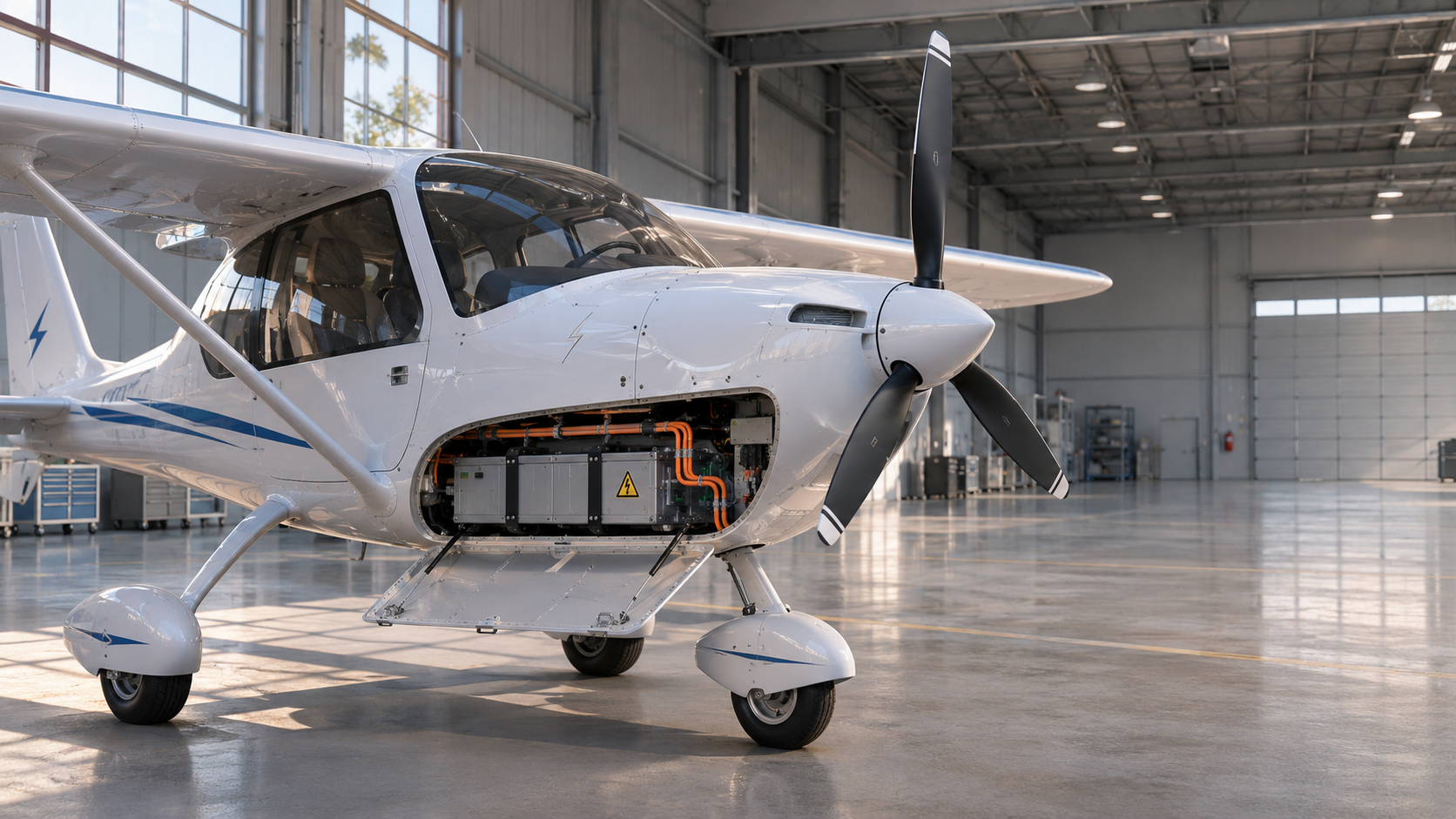
Cell-level specific energy, expressed as watt-hours per kilogram, describes energy relative to cell mass under specified test conditions. Aircraft performance depends on the mass and energy of the installed system. Enclosures, electrical connections, protection devices, thermal management, containment features, and supporting structure all add mass. Some of those items may be counted in the battery assembly and others in the airframe, so the accounting boundary matters as much as the headline figure.
Installed specific energy is found by dividing energy available at the chosen system boundary by the mass included within that same boundary. When comparing two designs, the numerator and denominator must refer to equivalent hardware. A figure based on nominal cell energy and cell mass cannot be compared directly with one based on delivered energy and the mass of a complete installed pack.
Even installed nominal energy is not all available for the planned route. The portion that can be used depends on discharge limits, battery temperature, cell condition, voltage limits, and the power demanded during flight. Electrical losses between the cells and propulsors reduce the energy available for useful propulsion; cooling and other onboard loads consume energy as well. If those losses are already incorporated into a mission simulation, subtracting them again would understate range.
Reserve energy has a separate role. It is carried to support the required contingency and landing strategy, so it contributes to mass while remaining unavailable for the planned route. Reserve assumptions must be stated explicitly: a range calculated down to a low battery state of charge is not directly comparable with a dispatch range that retains energy for a defined diversion or other contingency.
Payload and range share the same mass limit
At a specified maximum takeoff mass, the mass budget must accommodate the empty aircraft, installed battery, occupants or cargo, and other required items. If the aircraft is already at its limit, increasing battery mass requires an equivalent reduction elsewhere unless an approved design change raises the limit. Consequently, a range figure without its associated payload leaves a central part of the trade-off unstated.
Consider two configurations of the same aircraft at the same takeoff mass. One carries more payload and a smaller battery; the other exchanges some payload for battery. The second has more stored energy without a higher takeoff weight, so its range can increase substantially. That result does not establish that the aircraft can carry the original payload over the longer distance. The fair comparison is a payload–range curve with the same operating assumptions, rather than two isolated maximum-range numbers.
Weight limits also extend beyond a single takeoff value. Battery placement changes the center of gravity and structural loads. A pack mounted far from the permissible center-of-gravity range can require changes in payload placement or additional structure. Those changes affect the usable mass budget and can offset some of the expected benefit of a higher-energy battery.
Mission profile changes the penalty
For a fixed-wing aircraft, cruise efficiency is only one part of the calculation. Takeoff and climb demand high power, while descent and landing have different energy requirements. On a short route, the energy used outside cruise can represent a large share of the mission; on a longer route, cruise performance has greater influence. A single watt-hours-per-distance figure taken from steady cruise will therefore overstate route capability if it omits the rest of the flight.
Wind changes ground range without changing the distance flown through the air. A headwind increases the time and energy required to reach a destination at a given airspeed, while a tailwind has the opposite effect. A credible range comparison states whether it uses still air or a defined wind, and whether range is measured over the ground or through the air.
Vertical-takeoff aircraft face a different weight sensitivity. During hover, rotors must generate thrust approximately equal to aircraft weight, and increased weight raises the power needed to sustain lift. Hover time, transition, climb, and approach can therefore consume a significant share of a short mission’s energy. A heavier battery may add useful cruise energy while simultaneously making each vertical segment more demanding. The result depends on rotor and aircraft design as well as the time spent in each flight mode.
Ambient conditions also change the calculation. High temperature or altitude reduces air density, affecting lift, rotor performance, cooling, and available operating margins. Cold battery temperatures can restrict discharge or charging until the pack reaches an appropriate condition. A range estimate tied to one atmospheric and battery temperature cannot automatically be applied to another.
Energy capacity does not guarantee required power
Range is often discussed in kilowatt-hours, but an aircraft must also deliver power in kilowatts at demanding points in the mission. Takeoff, climb, hover, and a diversion after an abnormal event can impose different power requirements from cruise. A battery with sufficient nominal energy may be unable to supply the required power at a low state of charge, at an unfavorable temperature, or after degradation.
This creates an operational floor on usable energy. If the battery must retain enough state of charge to meet a later power demand, some energy remains inaccessible for the preceding cruise even before a separate reserve is considered. The power requirement and reserve may overlap in a mission model, so they must be represented consistently rather than simply added together.
High discharge current also creates heat and voltage drop. Thermal limits can restrict continuous power, while additional cooling hardware adds mass and may draw electrical power. Increasing cell count or selecting cells with stronger power capability can relieve one constraint, but the resulting system mass and usable energy must be recalculated. A design optimized for a long, low-power cruise will not necessarily suit repeated high-power vertical departures.
Battery aging and the range used for dispatch
As a battery ages, capacity and power capability can decline. The effect on range is not captured by capacity loss alone: increased internal resistance can raise heat generation and reduce voltage under load, causing a power or voltage limit to be reached earlier. Temperature, cycling history, and time all influence the condition of a particular pack.
A new-pack range calculation is therefore a starting condition, not a complete operating envelope. A mission assessment should identify the assumed battery state of health and show that both energy and power remain adequate at the condition selected for continued operation. If battery replacement is planned before a specified performance threshold, the usable range and payload assumptions should correspond to that threshold, rather than only to a new pack.
Reading a range claim against its assumptions
A technically useful range figure identifies the aircraft configuration, installed battery mass, usable energy, payload, and takeoff mass. It also defines the route and flight profile, cruise speed and altitude, atmospheric conditions, auxiliary loads, battery condition, and energy retained on landing. These inputs allow a result to be reconstructed or compared with another estimate on a consistent basis.
Certification and operational requirements add constraints to that calculation. The applicable requirements depend on the aircraft category, propulsion architecture, intended operation, and certification basis. Battery safety, continued safe operation, power availability, and reserve arrangements must be addressed within that basis; a favorable theoretical energy balance alone does not establish an approved operating range.
The most revealing comparison holds the mission and payload constant, then varies battery mass while recalculating aircraft weight, power demand, thermal behavior, and landing energy. Where the mission reaches a structural, power, or reserve limit before it reaches an energy limit, adding cells alone will not resolve the constraint.
Article Categories
SYSTEM_ALERT_URGENT
Q3 SYMPOSIUM ON ORBITAL DYNAMICS
Registration for the Orbital Aerospace technical committee is now open. Node access required.
Taglist:
Recent Articles
 Nov 22, 2026How does redundancy handle component failures in rail signaling?How does redundancy handle component failures in rail signaling?
![]() Nov 21, 2026Middle Eastern Countries Oppose EU Aviation Emissions Proposal at ICAOMiddle Eastern Countries Oppose EU Aviation Emissions Proposal at ICAO
 Nov 21, 2026How are reference aircraft used in unmanned aircraft R&D?How are reference aircraft used in unmanned aircraft R&D?
![]() Nov 20, 2026Helios Horizon Completes Solid-State Battery Test Flight, Sets Three World RecordsHelios Horizon Completes Solid-State Battery Test Flight, Sets Three World Records
 Nov 20, 2026How does battery weight affect electric aircraft range?How does battery weight affect electric aircraft range?
![]() Nov 19, 2026ICEYE's €2 Billion Avio Bid Meets Italian Government ResistanceICEYE's €2 Billion Avio Bid Meets Italian Government Resistance
 Nov 19, 2026Is EN 9100 certification mandatory for aerospace suppliers in Europe?Is EN 9100 certification mandatory for aerospace suppliers in Europe?
![]() Nov 18, 2026ULA Says Vulcan Failure Began at Liftoff; 40 Amazon Satellites LostULA Says Vulcan Failure Began at Liftoff; 40 Amazon Satellites Lost
 Nov 18, 2026How to verify load ratings from an industrial rigging equipment factoryHow to verify load ratings from an industrial rigging equipment factory
![]() Nov 17, 2026Collins Aerospace Breaks Ground on Propeller MRO Facility in IndiaCollins Aerospace Breaks Ground on Propeller MRO Facility in India
 Nov 17, 2026How to use a transportation benchmarking database to compare freight costsHow to use a transportation benchmarking database to compare freight costs
![]() Nov 16, 2026Beijing Drone Rules Ban Flight, Possession and Storage Across the CityBeijing Drone Rules Ban Flight, Possession and Storage Across the City
 Nov 16, 2026How does redundancy support safe autonomous aviation?How does redundancy support safe autonomous aviation?
![]() Nov 15, 2026SpaceX Catches Orbital-Class Starship on Flight 15SpaceX Catches Orbital-Class Starship on Flight 15
 Nov 15, 2026How does system integration affect smart railway station costs?How does system integration affect smart railway station costs?
![]() Nov 14, 2026SpaceX Starship Flight 15 Reaches Orbit as Booster Diverts to SplashdownSpaceX Starship Flight 15 Reaches Orbit as Booster Diverts to Splashdown
 Nov 14, 2026How to verify a technical compliance reference for avionicsHow to verify a technical compliance reference for avionics
![]() Nov 13, 2026Hydrogen Aviation Startups Seek Near-Term Revenue in Defense and Data CentersHydrogen Aviation Startups Seek Near-Term Revenue in Defense and Data Centers
 Nov 13, 2026How to use procurement planning resources to set lead timesHow to use procurement planning resources to set lead times
![]() Nov 12, 2026Hydrogen Aviation Startups Turn to Defense and Data Centers for RevenueHydrogen Aviation Startups Turn to Defense and Data Centers for Revenue
 Nov 12, 2026How does a multimodal logistics hub warehouse connect rail and road freight?How does a multimodal logistics hub warehouse connect rail and road freight?
![]() Nov 11, 2026FAA Rolls Out SMART AI Traffic Management System Across 22 CentersFAA Rolls Out SMART AI Traffic Management System Across 22 Centers
 Nov 11, 2026How does runway traffic management prevent runway incursions?How does runway traffic management prevent runway incursions?
![]() Nov 10, 2026FAA Starts Air Traffic Control Upgrade, Phasing Out 8-Inch Floppy DisksFAA Starts Air Traffic Control Upgrade, Phasing Out 8-Inch Floppy Disks
 Nov 10, 2026How to assess data comparability in industrial technology benchmarking softwareHow to assess data comparability in industrial technology benchmarking software
![]() Nov 09, 2026Marble Imaging Raises €6 Million for German VHR Satellite ConstellationMarble Imaging Raises €6 Million for German VHR Satellite Constellation
 Nov 09, 2026How does cryogenic propulsion for upper stages affect payload capacity?How does cryogenic propulsion for upper stages affect payload capacity?
![]() Nov 08, 2026SpaceX Plans Starship Flight 15 on November 13 With Two-Stage Catch AttemptSpaceX Plans Starship Flight 15 on November 13 With Two-Stage Catch Attempt
 Nov 08, 2026How to verify an aerospace technical reference is currentHow to verify an aerospace technical reference is current
![]() Nov 07, 2026NTSB: Southwest 737 MAX Flew 44 Times After Missed Storm Check, Leading to Dutch RollNTSB: Southwest 737 MAX Flew 44 Times After Missed Storm Check, Leading to Dutch Roll
 Nov 07, 2026How to reduce springback when bending automotive sheet metalHow to reduce springback when bending automotive sheet metal
![]() Nov 06, 2026AutoFlight Completes First Autonomous Formation Flight With Five Mixed-Weight eVTOLsAutoFlight Completes First Autonomous Formation Flight With Five Mixed-Weight eVTOLs
 Nov 06, 2026How to find current avionics standards in global aerospace technical referencesHow to find current avionics standards in global aerospace technical references
 Nov 05, 2026How does aircraft certification differ across the Middle East?How does aircraft certification differ across the Middle East?
![]() Nov 04, 2026Spain’s Transport Minister Resigns After Fatal High-Speed Rail CollisionSpain’s Transport Minister Resigns After Fatal High-Speed Rail Collision