How to qualify aerospace manufacturing components for traceability
Lead Author
Published
Views:
How to Qualify Aerospace Manufacturing Components for Traceability
Qualifying aerospace manufacturing components for traceability is not a matter of putting a serial number on a finished part. A number without supporting evidence is only an identifier. True traceability creates a defensible chain between the installed component and its material source, approved design definition, manufacturing route, special-process records, inspection results, handling history, and release status.
For quality-control and safety professionals, that chain must remain intact when the product is moved between facilities, reworked, assembled into a higher-level unit, returned from the field, or investigated after a nonconformance. The practical question is not “Can we locate this part?” It is “Can we prove what this part is, how it was made, whether it met the applicable requirements, and where all equivalent-risk material went?”
This distinction matters across aircraft structures, engines, avionics, spacecraft hardware, eVTOL systems, and ground transportation platforms operating in extreme environments. As supply chains extend across regions and manufacturing methods diversify, traceability becomes the operating language connecting engineering, production, procurement, quality, safety, and certification functions.
Start with the traceability objective, not the database
A common mistake is to begin with software selection, barcode formats, or an enterprise resource planning configuration. Those tools matter, but they cannot compensate for an unclear qualification model. The organization should first determine the level of traceability required for each component family and the safety, regulatory, contractual, and engineering reasons behind it.
The appropriate level is rarely identical for every item. A standard fastener, a forged landing-gear element, a composite pressure structure, a flight-control circuit board, and a cryogenic propulsion valve may all require traceability, yet the critical records and containment logic differ. A component with limited safety consequence may be controlled by lot. A life-limited or safety-critical item may require unique serialisation, controlled configuration, and direct linkage to every relevant manufacturing and inspection record.
Qualification should therefore begin with a documented risk assessment. Consider the part’s function, failure modes, critical characteristics, material sensitivity, repairability, expected service environment, supplier complexity, and potential for counterfeit or substitution risk. The output should define what must be traceable, at what unit of control, for how long, and through which systems of record.
This is also where teams must separate part identification from configuration control. A part can carry the correct serial number while still being built to an obsolete drawing revision, an unapproved software baseline, or a superseded process specification. Qualification is incomplete unless the component record identifies the applicable design and process configuration at the time of manufacture.
Define the evidence package for every traceability level
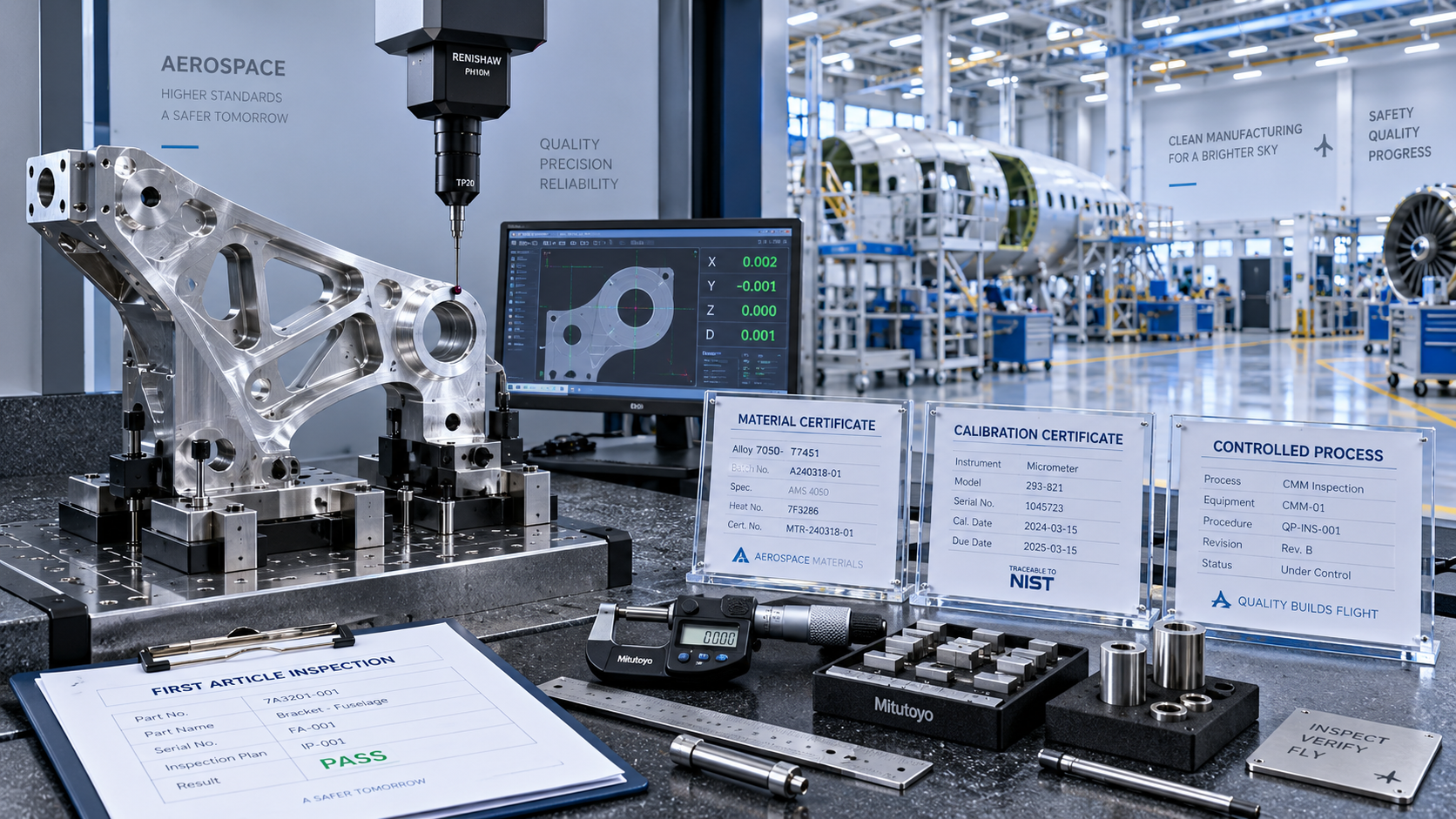
For aerospace manufacturing components, the evidence package should be designed backward from the question an auditor, investigator, or airworthiness authority may ask years later: “Show me the objective evidence that this hardware conforms.” The answer should not depend on the memory of one production supervisor or on files scattered across several suppliers.
A usable traceability record typically links the following information:
- part number, description, serial number or lot number, and status;
- approved drawing, model-based definition, specification, and revision level;
- raw-material heat, batch, melt, cure batch, or other relevant source identifier;
- supplier approval status and purchasing documentation;
- routing and work-order history, including manufacturing locations where relevant;
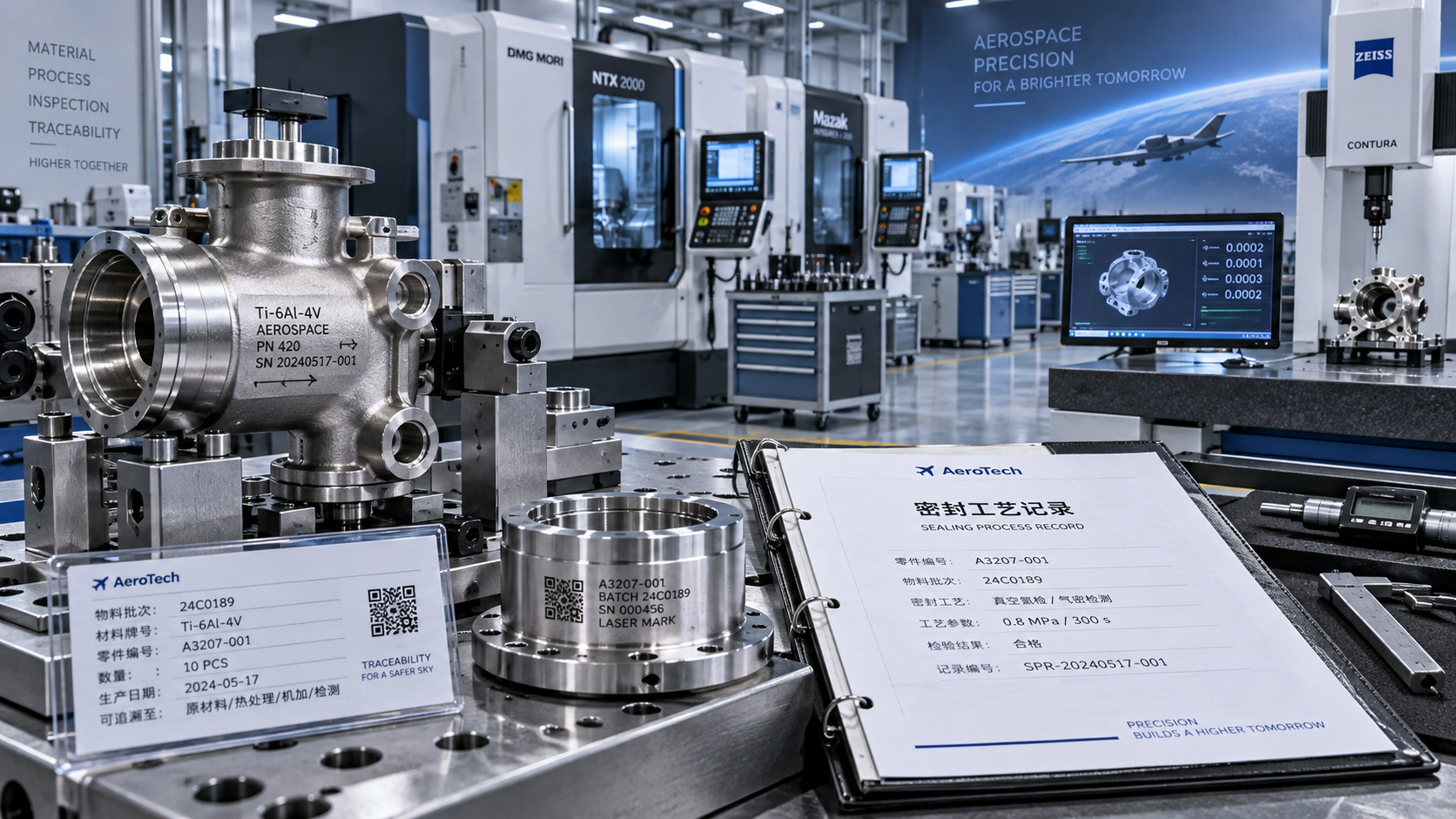
- special-process records such as heat treatment, welding, plating, bonding, non-destructive testing, or composite cure cycles;
- inspection and test results, measurement equipment status, nonconformance records, and dispositions;
- rework, repair, concession, deviation, or approved change documentation;
- packaging, preservation, shelf-life, and environmental-control records where these affect conformity; and
- final release authority and the record retention route.
Not every component needs every record in the same form. For example, an adhesive-bonded structure may require strict control of material storage, out-time, lot association, surface preparation, and cure documentation. A machined metallic component may depend more heavily on material certification, machining-route control, heat-treatment evidence, inspection of key features, and positive prevention of mixed material. The qualification plan should name the required evidence rather than relying on broad phrases such as “full traceability.”
Qualify the chain from incoming material to installed assembly
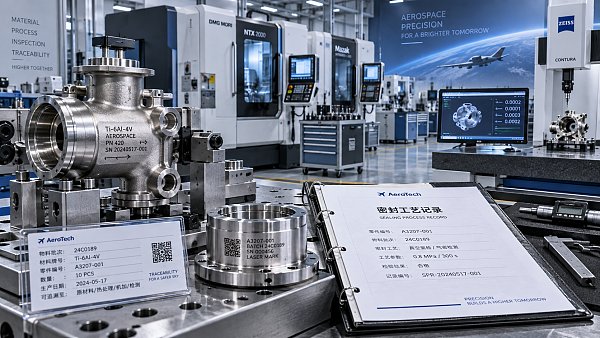
The traceability chain is usually most vulnerable at handoffs. Material arrives with a certificate, is divided into smaller quantities, processed in another facility, temporarily stored, incorporated into subassemblies, and eventually delivered as a finished unit. At every handoff, identifiers can be lost, transcribed incorrectly, or detached from the physical item.
Incoming inspection is the first control point. The team should verify that material documentation corresponds to the purchase order and technical requirements, that the source is acceptable under the organization’s approved-supplier process, and that labels, quantities, and condition are consistent with the documentation. Material certificates should not be accepted as proof merely because they are present. Their relevance to the ordered specification, heat or batch identification, and product form must be checked.
After receipt, the physical and digital identity must remain synchronized. If a lot is split, each child lot needs an unambiguous link to its parent. If material is blended, consumed, scrapped, or returned, the record must preserve the relationship. This sounds elementary, yet lot splitting and partial consumption are frequent weak points because they occur on the shop floor under time pressure.
For serialised components, the manufacturing traveler or electronic route should become the backbone of the component history. It should prevent progression when required records are absent, incomplete, or outside approved limits. A manually signed traveler can still serve as a controlled record where appropriate, but only if identity, revision control, legibility, and archival retrieval are managed rigorously. Digitisation improves retrieval and analysis; it does not remove the need for disciplined process ownership.
Treat special processes as a traceability stress test
Many of the most consequential characteristics of an aerospace part cannot be confirmed by final visual inspection. Heat treatment, welding, brazing, chemical processing, coating, composite curing, bonding, and non-destructive testing can alter material properties or reveal defects in ways that are not obvious after the fact. That makes special-process traceability central to qualification.
The record should establish who performed the process, against which approved procedure and revision, using which qualified personnel and equipment, with what process parameters, and under what acceptance criteria. The degree of detail depends on the specification and part criticality. In some cases, batch-level linkage is appropriate; in others, the component must be tied directly to a specific furnace load, autoclave cycle, inspection image set, or process run.
Qualification teams should be especially cautious when a supplier provides only a statement of conformity without sufficient supporting linkage. A statement may be a required release document, but it is not automatically a substitute for the underlying records required by the contract, engineering authority, or quality-management system. The necessary depth should be established before production begins, not during an audit or escape investigation.
Use standards as a framework, then apply the program requirements
Aerospace organizations commonly build their quality systems around standards such as AS9100 or EN 9100, which include requirements related to identification, traceability, configuration management, control of externally provided processes, nonconforming outputs, and documented information. These standards provide an important management-system foundation, but they do not eliminate the need to examine the specific contract, drawing notes, customer requirements, and applicable airworthiness or space program obligations.
FAA and EASA requirements may shape how production approval holders, repair organizations, and other regulated entities manage conformity and records, while customer-controlled specifications often define the exact traceability content for a component. For space, defense, rail, and urban air mobility programs, the governing requirements may vary by jurisdiction, contractual structure, and intended operation. It is risky to assume that a generic quality certificate automatically satisfies program-level traceability obligations.
This is why benchmark-oriented organizations such as Global Aerospace & Advanced Transportation-Intelligence examine technical performance alongside the certification and operational context. Whether the subject is a next-generation composite fuselage, cryogenic rocket hardware, maglev signalling equipment, or autonomous air-taxi controls, the core question remains similar: can the organization connect the physical asset to reliable, reviewable evidence across its lifecycle?
Validate traceability through retrieval and containment drills
A traceability process is not qualified because its procedure has been approved. It is qualified when it can be tested under realistic conditions. Retrieval drills are among the clearest ways to expose weaknesses. Select a finished component, then ask the responsible teams to retrieve the full history within a defined internal timeframe: material origin, process records, inspection status, deviations, related assemblies, and shipment or installation information.
Run the drill in both directions. Forward tracing begins with a suspect material lot or process batch and identifies every affected component, assembly, and delivery. Backward tracing begins with a field-returned serial number and reconstructs its manufacturing and supply history. The two exercises test different capabilities. A system may retrieve a component file easily yet fail to identify all hardware exposed to the same out-of-tolerance furnace cycle.
The audit should also test exception handling. Can the organization distinguish an approved repair from an undocumented rework? Can it show that scrapped material was removed from usable inventory? Can it demonstrate control when a label is damaged, an electronic record is corrected, or a subcontractor changes a process location? These are the situations in which nominally compliant systems often break down.
Common failures that undermine component history
The most damaging gaps are often procedural rather than technological. Teams may copy material data into a traveler without retaining the original certificate reference. Suppliers may issue certificates with inconsistent part nomenclature. Production may permit “use as is” decisions without a controlled disposition. Inspection results may be stored separately from serial-number history. A subcontracted process may be approved at the supplier level but not for the particular specification revision or process scope used.
Another recurring issue is over-serialisation. Assigning unique serial numbers to everything can create administrative burden without improving risk control if the organization cannot maintain reliable parent-child relationships, scanning discipline, and record governance. The better approach is proportionate traceability: enough granularity to support safety, conformity, containment, maintenance, and contractual obligations, but not a complex system that operators work around.
Build traceability into production readiness
Before releasing a new component or supplier to production, quality and safety teams should confirm that the traceability method is visible in the process flow, inspection plan, work instructions, purchasing controls, and configuration-management process. The method should survive ordinary operational realities: shift changes, supplier transfers, split lots, rework, repairs, shortages, production-rate changes, and eventual record retrieval years after delivery.
The strongest qualification packages do not simply state that aerospace manufacturing components are traceable. They define the evidence, assign accountability, test retrieval, and make gaps visible before a component reaches a safety-critical application. Where requirements span commercial aviation, space infrastructure, high-speed rail, or emerging UAM platforms, the exact records may differ. The discipline does not: preserve identity, preserve configuration, preserve objective evidence, and prove that affected hardware can be found when it matters.
Article Categories
SYSTEM_ALERT_URGENT
Q3 SYMPOSIUM ON ORBITAL DYNAMICS
Registration for the Orbital Aerospace technical committee is now open. Node access required.
Recent Articles
![]() Oct 27, 2026FAA Certifies Boeing 737 MAX 10 After Years of DelaysFAA Certifies Boeing 737 MAX 10 After Years of Delays
 Oct 27, 2026Can an intermodal connectivity platform reduce rail handoff delays?Can an intermodal connectivity platform reduce rail handoff delays?
![]() Oct 26, 2026Chery Unveils Global Smart Mobility Strategy Targeting Robotaxis and eVTOLsChery Unveils Global Smart Mobility Strategy Targeting Robotaxis and eVTOLs
 Oct 26, 2026How to evaluate avionics for helicopters used in IFR operationsHow to evaluate avionics for helicopters used in IFR operations
![]() Oct 25, 2026Ukraine’s Defence Minister Says SpaceX Satellite Services Restored After Speed RestrictionsUkraine’s Defence Minister Says SpaceX Satellite Services Restored After Speed Restrictions
 Oct 25, 2026How satellite infrastructure for IoT affects sensor reporting delaysHow satellite infrastructure for IoT affects sensor reporting delays
![]() Oct 24, 2026China Successfully Launches Yaogan 50-03 SatelliteChina Successfully Launches Yaogan 50-03 Satellite
 Oct 24, 2026How gradients affect traction power needs in high-speed rolling stockHow gradients affect traction power needs in high-speed rolling stock
![]() Oct 23, 2026FAA Proposes Checks on Nearly 2,000 Boeing 737NGs Over Loss-of-Control RiskFAA Proposes Checks on Nearly 2,000 Boeing 737NGs Over Loss-of-Control Risk
 Oct 23, 2026How fuel choice affects specific impulse in liquid oxygen propulsionHow fuel choice affects specific impulse in liquid oxygen propulsion
![]() Oct 22, 2026QuantumScape Plans 100 MWh Solid-State Battery Line Targeting Aerospace and Other MarketsQuantumScape Plans 100 MWh Solid-State Battery Line Targeting Aerospace and Other Markets
 Oct 22, 2026How tank size limits hydrogen aircraft range on regional flightsHow tank size limits hydrogen aircraft range on regional flights
![]() Oct 21, 2026FAA Certifies Boeing 737-10, Clearing Regulatory Hurdle for DeliveriesFAA Certifies Boeing 737-10, Clearing Regulatory Hurdle for Deliveries
 Oct 21, 2026How are electric vertical takeoff aircraft certified in the US?How are electric vertical takeoff aircraft certified in the US?
![]() Oct 20, 2026Ohio Department of Transportation Releases Three-Year Advanced Air Mobility Action PlanOhio Department of Transportation Releases Three-Year Advanced Air Mobility Action Plan
 Oct 20, 2026How does magnetic flux density in tesla affect maglev lift force?How does magnetic flux density in tesla affect maglev lift force?
![]() Oct 19, 2026ZeroAvia Completes Key Ground Tests of ZA600 Hydrogen Fuel Cell PowertrainZeroAvia Completes Key Ground Tests of ZA600 Hydrogen Fuel Cell Powertrain
 Oct 19, 2026How spacecraft integration affects advanced propulsion costsHow spacecraft integration affects advanced propulsion costs
 Oct 18, 2026How chilldown prevents cavitation in cryogenic engine systemsHow chilldown prevents cavitation in cryogenic engine systems
 Oct 17, 2026How explainability affects algorithmic trust in AI flight systemsHow explainability affects algorithmic trust in AI flight systems
 Oct 16, 2026How to evaluate transportation technology for Middle East heatHow to evaluate transportation technology for Middle East heat
 Oct 15, 2026How common-cause failures defeat redundancy logic in European avionicsHow common-cause failures defeat redundancy logic in European avionics
 Oct 14, 2026How DO-160 applies to aerospace technology testing for avionicsHow DO-160 applies to aerospace technology testing for avionics
 Oct 13, 2026How fuel price volatility shapes commercial aviation cost trendsHow fuel price volatility shapes commercial aviation cost trends
 Oct 12, 2026How to qualify aerospace manufacturing components for traceabilityHow to qualify aerospace manufacturing components for traceability
 Oct 11, 2026Which certification hurdles are slowing hydrogen aviation in Europe?Which certification hurdles are slowing hydrogen aviation in Europe?
 Oct 10, 2026What evidence should a magnetic gap stability supplier provide?What evidence should a magnetic gap stability supplier provide?
 Oct 09, 2026Which ISO standards matter when qualifying industrial technology suppliers?Which ISO standards matter when qualifying industrial technology suppliers?
 Oct 08, 2026When does reusability actually lower launch vehicle costs?When does reusability actually lower launch vehicle costs?
 Oct 07, 2026Where to find reliable product knowledge resources in the Middle EastWhere to find reliable product knowledge resources in the Middle East
 Oct 06, 2026What drives high-speed rail systems cost per kilometer?What drives high-speed rail systems cost per kilometer?
 Oct 05, 2026When does hydrogen propulsion for UAV extend mission range enough to justify it?When does hydrogen propulsion for UAV extend mission range enough to justify it?
 Oct 04, 2026How rail systems integration reduces commissioning delaysHow rail systems integration reduces commissioning delays
 Oct 03, 2026How to evaluate an advanced propulsion manufacturer for hydrogen systemsHow to evaluate an advanced propulsion manufacturer for hydrogen systems
 Oct 02, 2026How to qualify aircraft components for OEM production approvalHow to qualify aircraft components for OEM production approval