When do aircraft instrumentation panels need to be replaced?
Lead Author
Published
Views:
Aircraft instrumentation panels need to be replaced when damage, deterioration, or an installation change leaves the existing panel unable to meet applicable airworthiness requirements and no suitable approved repair is available. A replacement may also be necessary when the panel cannot accommodate an approved avionics modification. Age alone, a scratched finish, or a failed instrument does not automatically mean the entire panel must be replaced.
The first distinction is what has actually failed. A cockpit panel may refer to the physical structure that supports instruments and controls, an individual display or instrument, or the associated wiring and equipment. Each can have a different maintenance remedy. Replacing the metal panel will not cure an intermittent connector, and replacing a display will not restore a cracked mounting structure.
Start by locating the defect, not by ordering a panel
Before deciding on replacement, document the reported symptom and identify the affected assembly using the aircraft’s maintenance data and parts information. Record where the defect appears, when it occurs, and whether it affects an instrument indication, a mounting point, the panel surface, or equipment behind it.
A loose instrument, for example, may result from a damaged fastener, worn mounting hardware, an enlarged hole, a distorted panel, or a defect in the instrument housing. Those findings lead to different corrective actions. Likewise, an unreliable indication could originate in a sensor, power supply, wiring, connector, or instrument rather than in the panel itself.
Use the applicable fault-isolation and inspection procedures, including any required precautions for electrical power, sensitive avionics, and access to nearby systems. When a defect affects an instrument or indication needed for the intended operation, determine aircraft dispatch status under the operator’s approved procedures and applicable operating rules. Do not assume that a readable display or an intermittent fault is automatically acceptable for flight.
Physical damage that can make replacement necessary
The panel must hold installed equipment securely and maintain the intended relationship between instruments, controls, placards, and the surrounding structure. Damage matters not only because of how it looks, but because vibration, repeated handling, and equipment loads can cause a local defect to spread or make an installation unreliable.
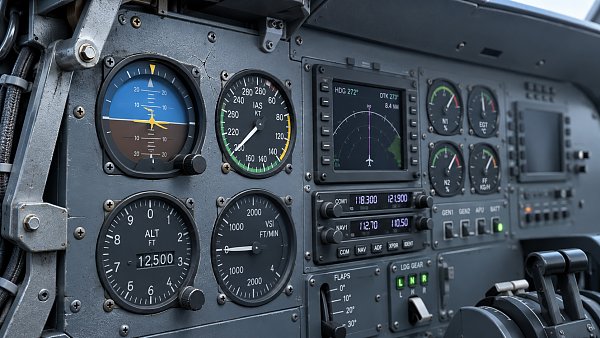
Cracks, distortion, and damaged mounting areas
Inspect around instrument cutouts, fastener holes, corners, brackets, and other areas where loads are transferred into the panel. A crack extending from a cutout or a mounting hole can compromise the support for an instrument even when the instrument itself operates normally. Bent sections, elongated holes, loose inserts, and damaged threads can also prevent equipment from being secured as intended.
The presence of a crack does not, by itself, establish that the whole panel must be discarded. The decision depends on its location, extent, panel construction, and whether the applicable maintenance data permits an effective repair. A defect near a highly loaded mounting point may have a different disposition from superficial damage to a nonstructural trim piece. Do not stop-drill, add fasteners, reinforce the area, or enlarge a cutout unless the applicable data permits that work or an approved repair has been developed.
Replacement becomes the practical route when damage exceeds allowable limits, an approved repair is unavailable or unsuitable, or a repair would leave the equipment unable to meet its installation requirements. Damage to adjacent supports or the surrounding aircraft structure must be assessed separately; installing a new panel over an unresolved structural problem does not restore the installation.
Corrosion, moisture, and material deterioration
Corrosion around fasteners, mounting brackets, and panel edges can weaken the material or make equipment difficult to secure. Moisture may also affect connectors and wiring behind an apparently sound panel. On nonmetallic panels, look for deterioration appropriate to the material and the applicable inspection instructions, such as cracking or separation around attachment points.
A localized surface condition may be removable within the limits of the maintenance data. More extensive material loss, damage at a critical attachment, or deterioration beyond permitted limits can require replacement. Before fitting a new panel, address the source of moisture or contamination and inspect affected nearby components; otherwise, the same defect may return.
When the instrument or wiring is the problem
A blank screen, fluctuating indication, failed backlight, or recurring power fault deserves investigation, but none proves that the physical panel is defective. Follow the relevant troubleshooting procedure to distinguish between the display or instrument, its power and data connections, remote equipment, and the panel-mounted hardware.
Check for chafed wiring, loose or damaged connectors, improper bonding where applicable, and harnesses strained by equipment removal or installation. The correct remedy might be repair of a harness, replacement of a connector, or replacement of an instrument. If the physical panel has sharp edges, damaged supports, or unsuitable cable routing that contributed to the fault, that condition also needs a disposition.
Repeated faults after an instrument has been exchanged are a reason to revisit the fault isolation, not to keep changing parts. Preserve the fault history, including operating conditions and any maintenance already performed. An intermittent indication that appears during vibration or temperature changes may require a different inspection approach from a fault that is present continuously.
Some assemblies combine the display, controls, and supporting structure more closely than a conventional instrument panel. In that case, the maintenance data determines the replaceable unit and the permitted level of repair. The term “panel replacement” in a work order should identify the actual part, not leave the scope open to interpretation.
Repair or replace: the decision points
A repair can be appropriate when the defect is within permitted limits, the prescribed method restores the required condition, and the necessary inspection and functional checks can be completed. Replacement is appropriate when those conditions cannot be met, when the applicable data calls for it, or when a suitable approved repair cannot be implemented.
Use these questions to organize the decision:
- What is damaged? Identify the panel, support, instrument, fastener, wiring, or another component before selecting a remedy.
- What limits apply? Compare the actual defect, including its location and extent, with the applicable maintenance and repair data.
- Is there an applicable repair? Confirm that the repair covers the installed configuration, material, damage, and intended use. A method used on a similar-looking panel is not automatically transferable.
- Will the installation remain compliant? Consider equipment security, clearances, markings, visibility, wiring protection, and other requirements affected by the work.
- Can the result be inspected and tested? Plan the required post-maintenance checks and any independent inspections applicable to the work.
If existing maintenance data does not provide a suitable disposition, the next step is to obtain an appropriately approved repair or modification through the applicable engineering and approval process. An improvised reinforcement or a replacement fabricated to match the old panel’s appearance is not a substitute for that process.
Replacement during an avionics upgrade
An otherwise serviceable panel may be unsuitable for a planned avionics change. New displays or controls can require different cutouts, support arrangements, clearances, lighting, placards, or access behind the panel. The upgrade may also change wiring routes or affect the visibility and operation of nearby equipment.
Compare the existing installation with the approved modification data before deciding whether to alter or replace the panel. Cutting a larger opening can remove material needed to support adjacent instruments. Moving one control can affect access to another. Equipment depth and connector clearance behind the panel can be as important as the space visible from the cockpit.
Some approved modifications permit alteration of the existing panel; others specify a replacement or a particular installation arrangement. Use the parts and instructions applicable to the aircraft’s configuration and the chosen modification. A panel that physically fits is not necessarily an acceptable substitute if its material, mounting provisions, markings, or installation configuration differ from those required.
Obsolescence is a planning concern rather than an automatic replacement criterion. If a serviceable instrument or panel is difficult to support, maintenance planning may favor an approved upgrade. That decision should account for available repair support, compatible replacement parts, aircraft downtime, and the scope of the modification, without treating parts scarcity as proof that the existing installation has failed.
Checks before releasing the aircraft
Whether the work involves a repaired mounting area, a replacement panel, or an avionics modification, the physical installation is only part of the job. The applicable maintenance instructions and operator procedures determine the required inspections, tests, records, and release.
Before closing the work package, pay particular attention to:
- Part and configuration control: Confirm the replacement’s identity and eligibility for the aircraft and installed equipment, including any modification-specific parts.
- Mounting and clearances: Inspect fasteners, supports, equipment security, control movement, and clearances in accordance with the installation data.
- Wiring and protection: Check connections, routing, support, and protection against chafing or interference with moving parts.
- Flight deck presentation: Inspect required labels, markings, lighting, and instrument visibility where affected by the work.
- Post-maintenance tests: Perform the specified electrical, instrument, system, and other functional checks. A successful power-up alone may not exercise every affected function.
- Records and release: Document the defect, corrective action, parts and data used, and required inspections and tests under the applicable maintenance and release procedures.
A clear handover should also identify any related findings that were assessed separately, such as moisture behind the panel or a recurring fault in a connected system. The useful endpoint is not simply a new-looking cockpit surface; it is a documented installation whose affected equipment and interfaces have been inspected and returned to service through the proper process.
Article Categories
SYSTEM_ALERT_URGENT
Q3 SYMPOSIUM ON ORBITAL DYNAMICS
Registration for the Orbital Aerospace technical committee is now open. Node access required.
Recent Articles
 Nov 22, 2026How does redundancy handle component failures in rail signaling?How does redundancy handle component failures in rail signaling?
![]() Nov 21, 2026Middle Eastern Countries Oppose EU Aviation Emissions Proposal at ICAOMiddle Eastern Countries Oppose EU Aviation Emissions Proposal at ICAO
 Nov 21, 2026How are reference aircraft used in unmanned aircraft R&D?How are reference aircraft used in unmanned aircraft R&D?
![]() Nov 20, 2026Helios Horizon Completes Solid-State Battery Test Flight, Sets Three World RecordsHelios Horizon Completes Solid-State Battery Test Flight, Sets Three World Records
 Nov 20, 2026How does battery weight affect electric aircraft range?How does battery weight affect electric aircraft range?
![]() Nov 19, 2026ICEYE's €2 Billion Avio Bid Meets Italian Government ResistanceICEYE's €2 Billion Avio Bid Meets Italian Government Resistance
 Nov 19, 2026Is EN 9100 certification mandatory for aerospace suppliers in Europe?Is EN 9100 certification mandatory for aerospace suppliers in Europe?
![]() Nov 18, 2026ULA Says Vulcan Failure Began at Liftoff; 40 Amazon Satellites LostULA Says Vulcan Failure Began at Liftoff; 40 Amazon Satellites Lost
 Nov 18, 2026How to verify load ratings from an industrial rigging equipment factoryHow to verify load ratings from an industrial rigging equipment factory
![]() Nov 17, 2026Collins Aerospace Breaks Ground on Propeller MRO Facility in IndiaCollins Aerospace Breaks Ground on Propeller MRO Facility in India
 Nov 17, 2026How to use a transportation benchmarking database to compare freight costsHow to use a transportation benchmarking database to compare freight costs
![]() Nov 16, 2026Beijing Drone Rules Ban Flight, Possession and Storage Across the CityBeijing Drone Rules Ban Flight, Possession and Storage Across the City
 Nov 16, 2026How does redundancy support safe autonomous aviation?How does redundancy support safe autonomous aviation?
![]() Nov 15, 2026SpaceX Catches Orbital-Class Starship on Flight 15SpaceX Catches Orbital-Class Starship on Flight 15
 Nov 15, 2026How does system integration affect smart railway station costs?How does system integration affect smart railway station costs?
![]() Nov 14, 2026SpaceX Starship Flight 15 Reaches Orbit as Booster Diverts to SplashdownSpaceX Starship Flight 15 Reaches Orbit as Booster Diverts to Splashdown
 Nov 14, 2026How to verify a technical compliance reference for avionicsHow to verify a technical compliance reference for avionics
![]() Nov 13, 2026Hydrogen Aviation Startups Seek Near-Term Revenue in Defense and Data CentersHydrogen Aviation Startups Seek Near-Term Revenue in Defense and Data Centers
 Nov 13, 2026How to use procurement planning resources to set lead timesHow to use procurement planning resources to set lead times
![]() Nov 12, 2026Hydrogen Aviation Startups Turn to Defense and Data Centers for RevenueHydrogen Aviation Startups Turn to Defense and Data Centers for Revenue
 Nov 12, 2026How does a multimodal logistics hub warehouse connect rail and road freight?How does a multimodal logistics hub warehouse connect rail and road freight?
![]() Nov 11, 2026FAA Rolls Out SMART AI Traffic Management System Across 22 CentersFAA Rolls Out SMART AI Traffic Management System Across 22 Centers
 Nov 11, 2026How does runway traffic management prevent runway incursions?How does runway traffic management prevent runway incursions?
![]() Nov 10, 2026FAA Starts Air Traffic Control Upgrade, Phasing Out 8-Inch Floppy DisksFAA Starts Air Traffic Control Upgrade, Phasing Out 8-Inch Floppy Disks
 Nov 10, 2026How to assess data comparability in industrial technology benchmarking softwareHow to assess data comparability in industrial technology benchmarking software
![]() Nov 09, 2026Marble Imaging Raises €6 Million for German VHR Satellite ConstellationMarble Imaging Raises €6 Million for German VHR Satellite Constellation
 Nov 09, 2026How does cryogenic propulsion for upper stages affect payload capacity?How does cryogenic propulsion for upper stages affect payload capacity?
![]() Nov 08, 2026SpaceX Plans Starship Flight 15 on November 13 With Two-Stage Catch AttemptSpaceX Plans Starship Flight 15 on November 13 With Two-Stage Catch Attempt
 Nov 08, 2026How to verify an aerospace technical reference is currentHow to verify an aerospace technical reference is current
![]() Nov 07, 2026NTSB: Southwest 737 MAX Flew 44 Times After Missed Storm Check, Leading to Dutch RollNTSB: Southwest 737 MAX Flew 44 Times After Missed Storm Check, Leading to Dutch Roll
 Nov 07, 2026How to reduce springback when bending automotive sheet metalHow to reduce springback when bending automotive sheet metal
![]() Nov 06, 2026AutoFlight Completes First Autonomous Formation Flight With Five Mixed-Weight eVTOLsAutoFlight Completes First Autonomous Formation Flight With Five Mixed-Weight eVTOLs
 Nov 06, 2026How to find current avionics standards in global aerospace technical referencesHow to find current avionics standards in global aerospace technical references
 Nov 05, 2026How does aircraft certification differ across the Middle East?How does aircraft certification differ across the Middle East?
![]() Nov 04, 2026Spain’s Transport Minister Resigns After Fatal High-Speed Rail CollisionSpain’s Transport Minister Resigns After Fatal High-Speed Rail Collision